


Click here to get my FREE Claude course (20+ lessons)
Most people think they get bad results from AI because they write bad prompts.
I used to think the same.
So I spent months collecting prompt tricks, magic words, and those giant “perfect prompt” templates people love to share.
Some of them helped.
But my results were still hit or miss, and I couldn’t figure out why.
Then it clicked. The problem wasn’t the prompts. The problem was that AI kept answering before it actually understood what I wanted.
Think about it.
If you ask a coworker to write a report and they start typing two seconds later, without a single question, you know it’ll miss the point.
A fast answer with no context is usually an average answer.
AI works the same way.
When you give it an empty brief, it fills the gaps with guesses. When AI guesses, you get generic output.
The good news is you can fix this without memorizing another prompt formula.
You only need to change one thing: make AI understand the task before it starts working on it.
Here’s what we’ll cover:
The Briefing Loop, the exact system I use to get better first drafts
Real examples for decision-making, writing, and more
How to save this context so you don’t have to repeat yourself every time
The Problem: AI Responds Too Fast
One of the biggest problems with AI is that it answers even when it has no clue what you actually want.
If you ask it to translate a sentence, fix a typo, or reformat a table, a fast answer is totally fine, but if you ask it to write an article, prepare a class, analyze a dataset, design a proposal, or help you make a decision, a fast answer is usually a bad sign.
Here quality doesn’t come from the model.
It comes from context.
And when the context is missing, AI just fills the gaps with average answers. That’s why so many outputs sound the same. Not because everyone uses the same tool, but because everyone feeds it the same empty instruction.
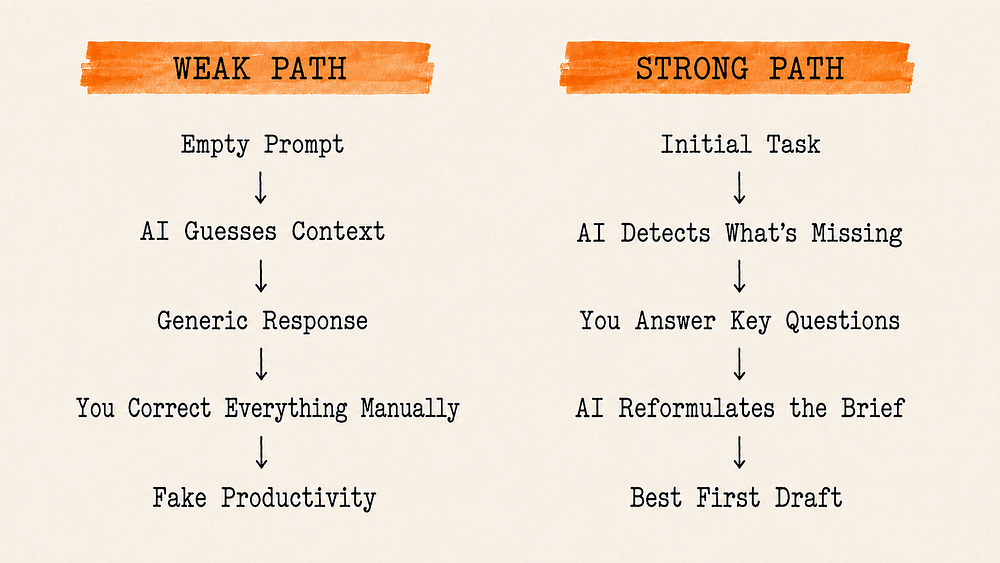
So what we want is simple. AI should start working only after it understands the task, not before. This is what this guide is about.
Prompting Is Asking. Briefing Is Preparing
A prompt says:
Do this.A brief says something like:
- This is the goal.
- This is who it's for.
- This is the tone.
- These are the limits.
- This is what I want to avoid.
- This is what a good result looks like to me.
Most people try to get better results by writing better prompts.
That helps, but only up to a point.
The real jump comes from somewhere else. It’s about giving direction and purpose to what you’re building, not just cleaner-sounding instructions.
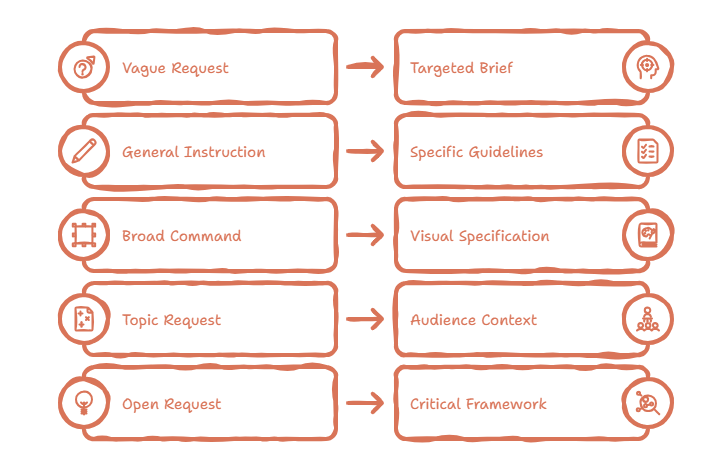
So the clearer the brief, the less the model has to guess.
AI’s First Job Shouldn’t Always Be to Answer
This is the most important shift.
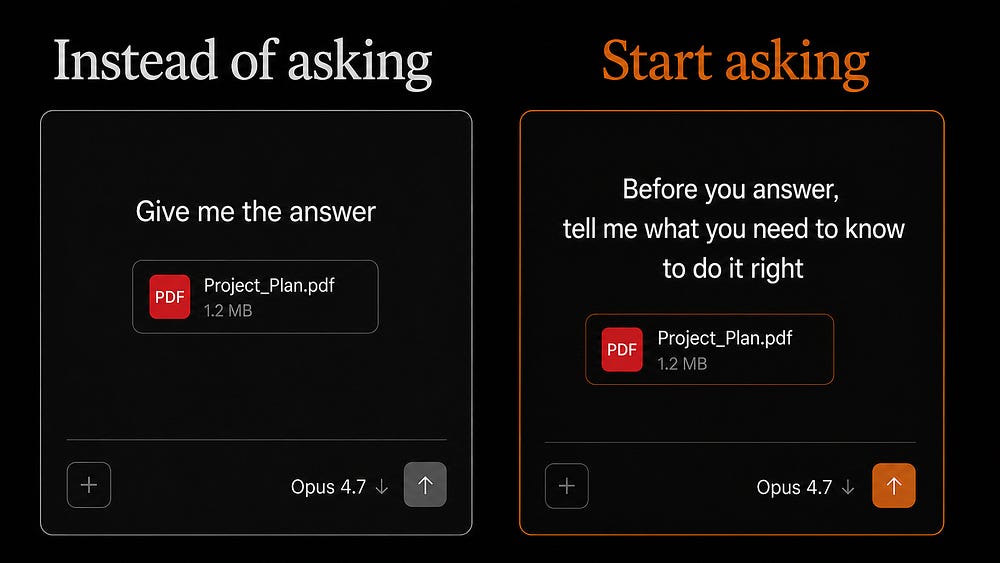
That shift changes the whole conversation.
AI stops acting like a machine that spits out text and starts working more like an editor, a consultant, a teacher, or a sparring partner.
Sometimes the best first response from AI isn’t an answer.
It’s a question.
Or even better, a short list of questions that show you what you haven’t made clear yet.
Picture this. You tell it:
I want to write an article about productivityA bad interaction is AI writing the article right away.
A better one is AI asking you first:
- Who is the article for?
- What problem do you want to solve?
- What common idea do you want to challenge?
- What examples do you want to include?
- What should the reader be able to do after reading it?
That already makes the article better before you write a single line.
The Solution: The Briefing Loop
Here’s the system.
It’s not complicated. But it completely changed the way I used to work with AI.
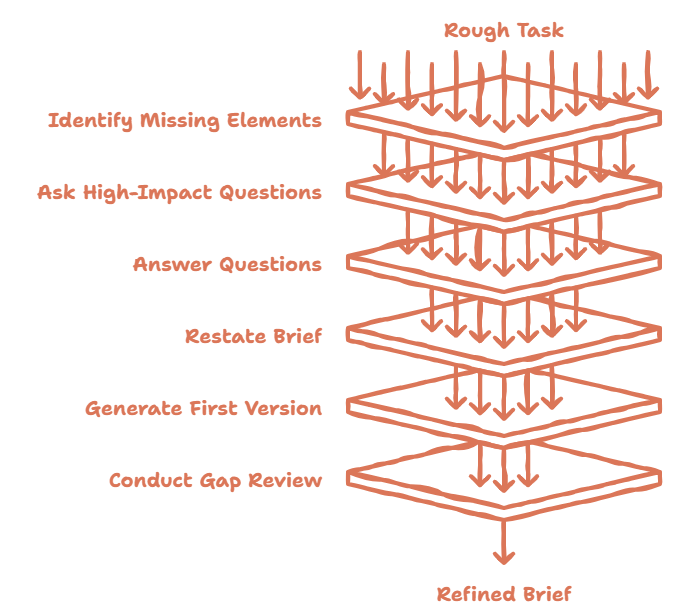
The goal is to stop AI from answering fast but badly.
Step 1: Start With a Rough Task
You don’t need to start with a perfect prompt.
That’s actually the whole point. You can start with something simple:
I want to write an article about why people get poor results from AIThis isn't a brief yet. It's just the rough task. It tells AI what you're trying to do, but it doesn't give it enough context to do it well.
That's exactly why the next step matters.
Step 2: Ask AI to Build the Brief Before Answering
Don’t ask AI to do the task yet. Ask it to turn your rough task into a proper brief first.
Use something like this:
Before you answer, turn my rough request into a proper brief.
Identify what context is missing or ambiguous.
Ask the fewest questions possible.
Only ask questions whose answers would change the final output.
If a question is nice to know but not necessary, skip it.
Ask no more than 3 questions for small tasks and no more than 5 questions for complex tasks.
Don't generate the final output yet.
This forces AI to pause.
And instead of rushing to finish the task with half the information, it helps you clarify the work first.
So before AI responds, you check:
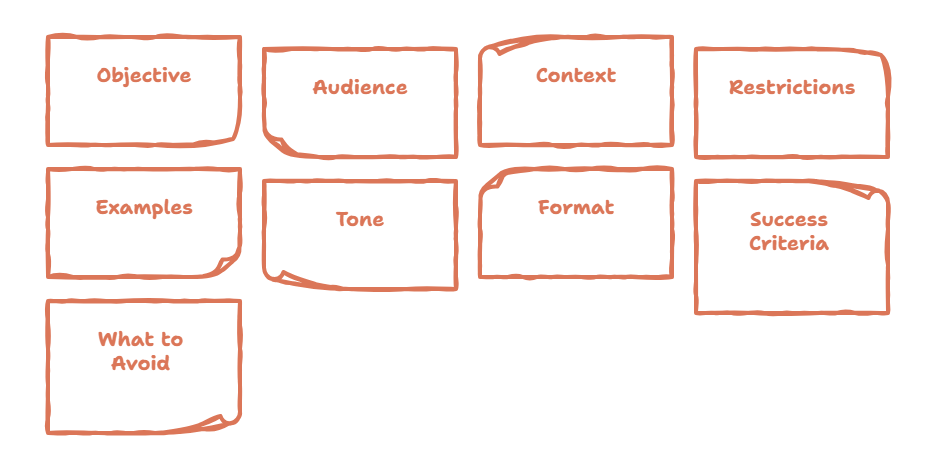
This checklist helps you reduce the guessing and, as a result, get better outputs.
After putting together the prompts from steps 1 and 2 and running them, expect some back-and-forth before Claude fully understands what you want. Once you’re both aligned, move on to step 3.
Step 3: Have It Restate the Brief
This step looks small, but it saves you from a lot of mistakes.
Before generating the final output, ask:
Before writing, restate the brief in your own words.

Include:

- Goal
- Audience
- Angle
- Constraints
- Expected format
- What to avoid
Why does this work?
Because if AI got the brief wrong, it will also get the result wrong. And it’s way easier to fix a five-line restatement than to fix a whole draft.
Step 4: Only Then Generate the First Version
Now it’s ready.
AI knows what it has to do.
It knows who it’s for.
It knows what to avoid.
It knows what format to follow.
It knows what “good” looks like.
That doesn’t guarantee a perfect answer. But it makes the first version a lot stronger.
And a strong first version matters more than it seems. Because when the first version is weak, everything after it turns into patches. This way, you save all the time you'd otherwise spend fixing the mess a bad brief creates.
Optional: Run a Gap Review
Once you get the first result, don't ask:
Can you improve it?That’s too limited.
Ask instead:
Review this result against the brief.

Tell me:

1. What’s strong
2. What’s still vague
3. What’s missing
4. What should be removed
5. What would make it more useful for the audience
This way AI doesn't just produce. It also becomes an evaluator.
Click here to get my FREE Claude course (20+ lessons)
Putting It Into Practice
Example 1: Writing an Article
Weak approach:
Write me an article about using AI better.Better approach:
I want to write an article for professionals who use AI every day but still get generic answers. The core idea is that the problem isn't bad prompts, it's bad briefs.
Before writing, review this brief. Ask me only the 5 most important questions needed to make the article specific, useful, and not generic.
AI might ask:
Who exactly is the reader?
What kinds of tasks do they use AI for?
What belief do you want to challenge?
What examples do you want to include?
What should the reader do differently after reading?
That already makes the article better before you write a single line.
Example 2: Teaching a Complex Topic
Weak approach:
Explain confidence intervals to meBetter approach:
I need to explain confidence intervals to students who are learning statistical inference for the first time. Before explaining, ask me what you need to know about their current level, the notation they know, the examples they've already seen, the mistakes they usually make, and whether the explanation should be intuitive, formal, or both. Don't explain anything yet.This completely changes the answer. Because "explain confidence intervals to me" can mean a lot of different things: a simple analogy, a formal derivation, an exam solution, or a script for a 10-minute class.
Example 3: Data Analysis
Weak approach:
Analyze this datasetBetter approach:
I'm going to analyze a dataset for a business report.
Before suggesting any analysis, ask me the essential questions about the business objective, the report's audience, the available variables, the decision the analysis should support, the expected technical level, and the final deliverable format. Don't start the analysis until the brief is clear
Because with AI you have to accept one thing: "analyze the dataset" isn't a goal. Analyze it for what? To predict, compare groups, find patterns, detect anomalies, make a decision, build a dashboard, or train a model? Each one points to a different analysis.
Example 4: Making a Decision
Weak approach:
Should I do this?Better approach:
I'm evaluating this decision: [describe the decision].
Before recommending anything, ask me the minimum number of questions needed to understand my goal, my constraints, the alternatives, the risk of being wrong, the cost of waiting, and what information would change the decision. Then give me a recommendation with trade-offs
Here, the method stops being just about productivity. It turns into a way of thinking and getting clarity, because the right questions:
Force you to clarify what you actually want.
Reveal constraints you never mentioned.
Surface risks you’ve been ignoring.
Help you separate a preference from a real decision.
One More Thing
You don’t need to use the Briefing Loop for everything.
Use it when the task involves ambiguity, judgment, or real consequences.
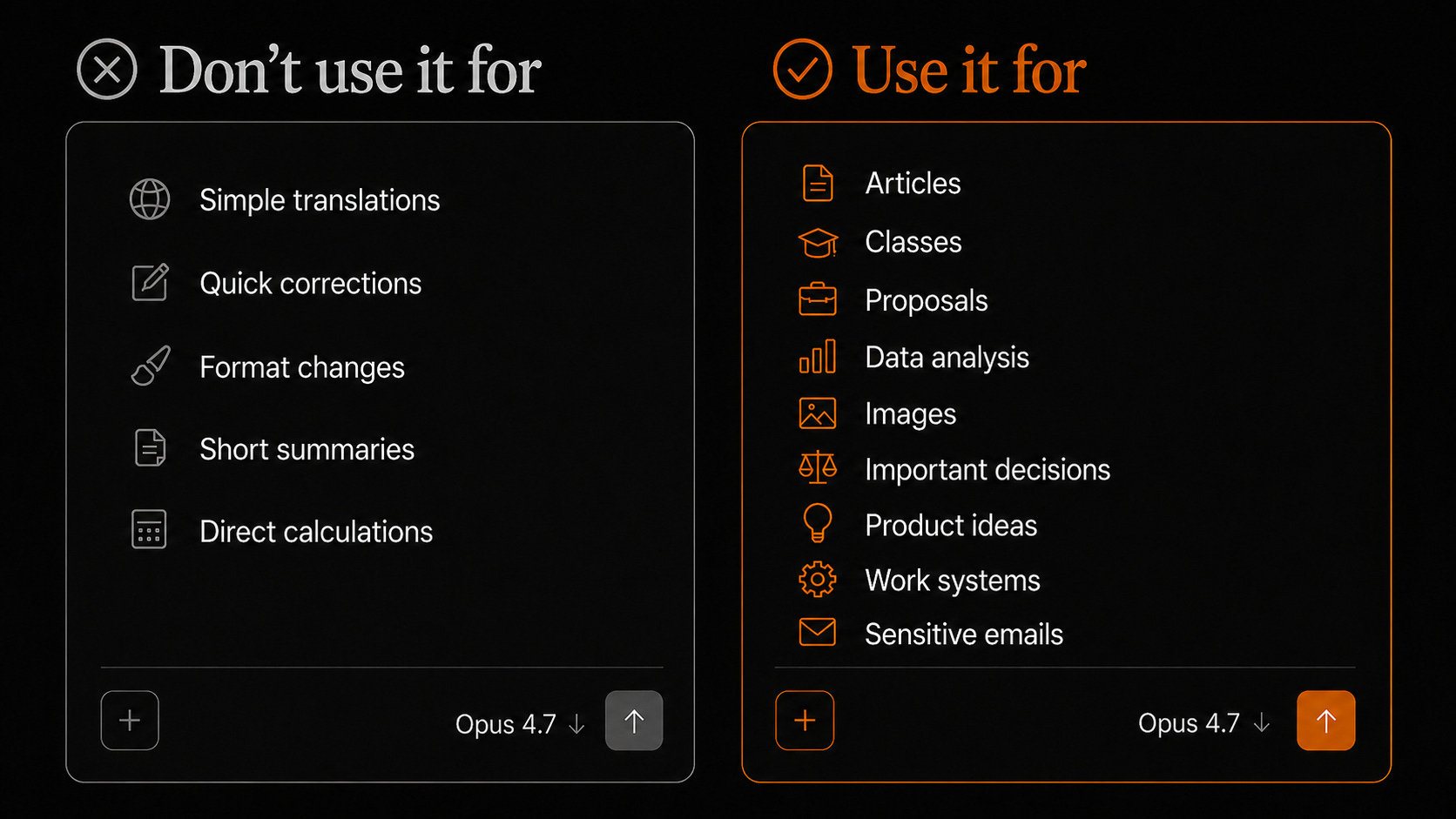
The key question is this:
Does AI need context to do this well?If the answer is no, just ask directly.
And one last thing.
If you keep explaining who you are, how you write, who your audience is, what tone you use, or what kind of results you expect, you’re basically writing the same brief over and over by hand.
That’s where context files come in.
A context file is a permanent brief. You write it once, and AI reuses it every time.
I just released My AI System. It contains a skill that generates context files tailored to your needs. Check it out: artificialcorner.com/p/ai-system
If this helped, subscribe to Artificial Corner. I share practical AI guides, Claude workflows, and systems you can actually use the same day you read them.
Join my newsletter with 70K+ people to master AI in 2026
A very fast response doesn't mean that you want the same answer, it is true that AI cannot understand the way you want the answer and sometimes gives the answer on guesses.
Yep Yep Yep, the real upgrade here isn’t a clever prompt, it’s giving AI enough of your actual world to stop guessing. That's what I do. That’s where it shifts from novelty machine to cognitive scaffold, goals, constraints, voice, what “useful” means, and the stuff I’m sick of repeating. A decent context file beats another 47-part “ultimate prompt” every time. Nice post sir!