

I’ve been obsessed with automation since I learned to code.
I used to spend hours writing scripts to automate the web, Excel reports, etc.
Thanks to Claude, now anyone can do this in minutes without writing code!
The best part? You can schedule tasks directly in Claude, so it runs them automatically on a recurring basis. Set it once and it just works, while you focus on everything else.
In this guide, I’ll show you step by step how to use Claude to schedule tasks like:
Weekly research: Track topics, competitors, or industry news
Daily reports: Compile data from spreadsheets into a formatted summary
Daily file organizer: Sort and clean up files in your downloads folder
For this, we’ll use two tools: Claude in Chrome to automate the web, and Claude Cowork to automate your files.
Twice a week, I share the best ways to get more out of Claude.
Click here to read our best Claude guides
and consider becoming a paid subscriber if you like my Claude guides 👇
Claude in Chrome: Automate the Web
Claude in Chrome is a Chrome extension that automates the web. To work with it, follow these steps:
Open Google Chrome
Go to Claude in Chrome → Click “Add to Chrome” to install
Sign in with your Claude account
Grant permissions so Claude can interact with your browser
The Claude icon will appear in your Chrome toolbar. Click it to open Claude in a side panel that stays visible while you browse.
Anything that involves repetitive web actions can be automated with this extension.
Just click the Claude sidebar while browsing any site, describe the task, and Claude will control your browser until it’s done.
Here’s one way Claude in Chrome has automated my work.
Every week, I track which Substack newsletters break into the top 200. I analyze what's working and spot potential collaborations.
To get data for my analysis, I have Claude scrape Reletter’s Substack charts with this prompt:
Build a table with the following columns for the first 250 elements in the table:
Ranking
Newsletter
Date (today’s date)
Type = free/paid
Give me a link to download the file in csv format
Here’s a video demo.
If you do this manually (clicks, copy-paste, etc), it takes forever. With Claude, it takes a couple of minutes.
It gets even better with the scheduled tasks feature. You can turn a prompt that works into a task that runs any time you want. Just click the three dots (at the top of the chat) and select “Convert to task.“

You’ll be redirected to the Claude in Chrome settings with the window below. Mine is empty, but if you clicked on “convert to task,“ the fields should be automatically filled based on your prompt.
Claude might tweak your prompt to make it more robust. Review it and adjust if necessary. Also, toggle on “schedule” and pick when the task should run.
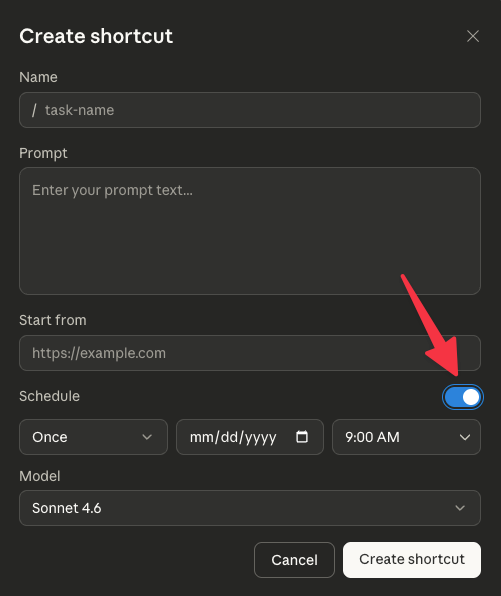
Once you’re happy with it, click on “Create shortcut.“
To edit a shortcut later: Go to Claude in Chrome settings (under the three dots) → Settings → Shortcut
You’ll see all your scheduled tasks listed there. I schedule mine to run every Tuesday.
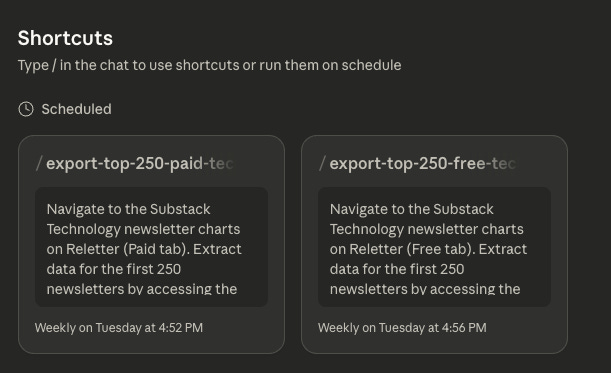
Now every week, Claude scrapes the site and downloads the data for me.
That’s how you automate the web. Now let’s see how to automate your desktop.
Scheduled tasks only run while your computer is awake
Important Note: I recommend you run Claude in Chrome from Claude Cowork (Cowork chat → + → Connectors → toggle on “Claude in Chrome“) Why? Because the automations you build within Chrome are isolated. They can’t connect with skills and other things you build in Cowork.
Cowork: Automate Your Files
Claude Cowork feels like a virtual employee, capable of managing files, organizing data, and performing multi-step tasks directly on your computer.
Recently, Cowork also got scheduled tasks!
It works a lot like Claude in Chrome. Write a prompt once, and Cowork can turn it into a scheduled task.
Here’s how to create a scheduled task from scratch:
Download Claude for desktop
Open the app and choose “Cowork“
Click “Scheduled” in the left sidebar
Click “+ New task”
Fill in the details (prompt, task name, etc)
Click “Save” to add a new task to the Scheduled tasks page.
We can also turn a working prompt into a task that runs whenever we want.
In the previous example, I used Claude in Chrome to set up a task that runs every Tuesday. It scrapes the data and generates a fresh dataset with a Substack newsletter ranking.
Now I’ll have Cowork analyze that data and generate a weekly report showing the 10 newsletters with the biggest gains and biggest drops.
Here’s the prompt I use:
Based on the data collected in the folder “Substack Newletter Ranking” generate an analysis that covers:
Biggest rank gains: Top 10 newsletters with the largest improvement (largest drop in rank number)
New entrants: Top 20 newsletters that appear in the rankings only in the most recent dataset
Biggest rank losses: Top 10 newsletters with the largest decline (greatest increase in rank number).
The folder contains two types of datasets:
Paid: rankings based on ARR
Free: rankings based on number of free email subscribers
Create the same analysis separately for each dataset (Paid and Free)
After running the task, Cowork drops a spreadsheet right in my folder with the full analysis. Congrats to the newsletters climbing fast … hope to be on the list soon :)
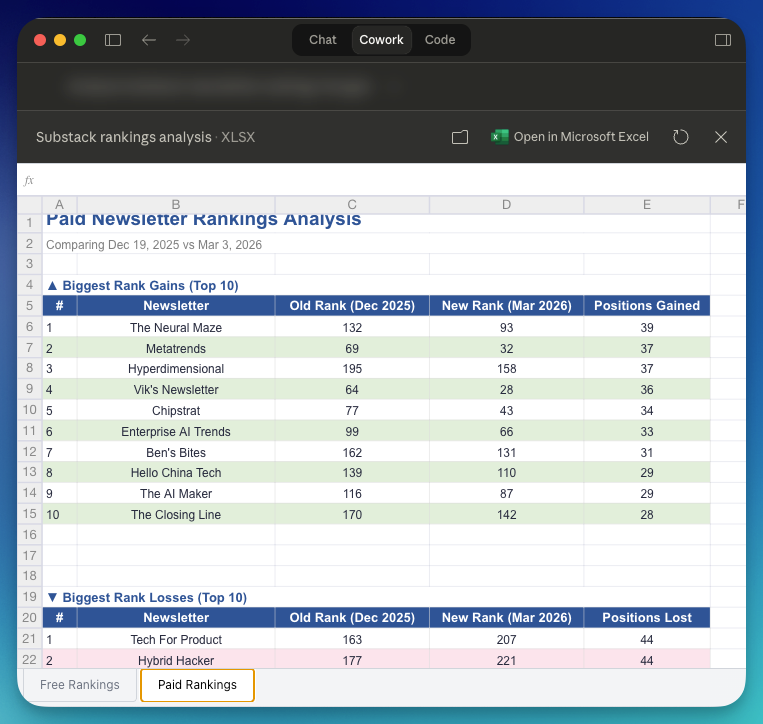
Now I can turn this working prompt into a scheduled task.
In the chat, click the dropdown arrow and select “schedule.”
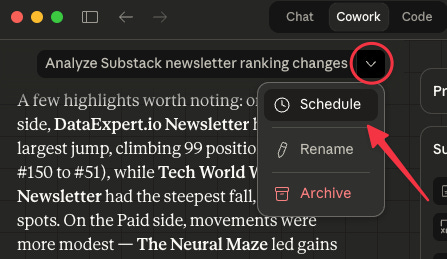
The /schedule command will appear. Type something like “run this every [day] at [time]“

My previous automation generates datasets on Tuesday around 5 PM, so for this one, I’ll schedule it a bit later: “run this every Tuesday at 5:10 PM.”
Cowork will ask for confirmation. Just press enter.
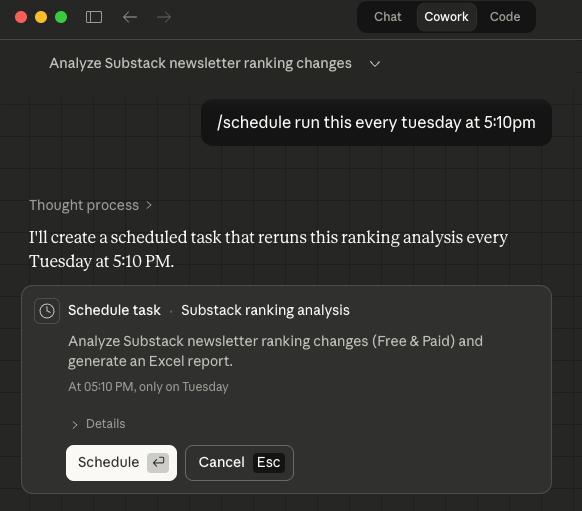
Your scheduled task has been created!
To view and manage all your scheduled tasks, open the left sidebar and select “Scheduled.”
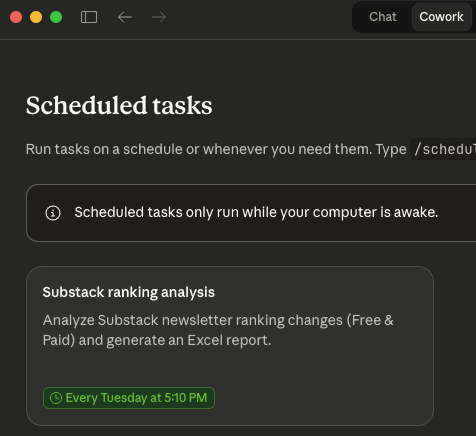
Important note: Scheduled tasks only run while your computer is awake and the Claude Desktop app is open.
Congrats! Now you know how to schedule tasks in Claude.
Check out this guide for more Cowork use cases.
Final thoughts
Not everything should run on autopilot. Review your chat history and identify which tasks actually benefit from being scheduled
You can schedule as many tasks as you like (Claude will happily work in the background), but each one draws from your daily usage allowance. The $20 Pro plan may be enough if you’re running a few lightweight tasks, but heavier workflows might call for the $100 or $200 tier
If this was helpful, consider becoming a paid subscriber. It helps me move up the Substack rankings (like my fellow writers!) and keeps these guides coming
I’m thinking of making a guide packed with Claude and Cowork use cases. If there’s a specific one you’d like covered, drop it in the comments.
I love this as inspiration... unfortunately, many corporate employees find it hard to do things like this when we're limited to specific tools (like Copilot in my case) for our work. Do you have any tips for applying this way of thinking in a more restricted environment? I'm trying to find creative ways around the system and write about what I learn, but I’d love to hear your thoughts!
Thanks for sharing such a detailed article. It is really useful. What I would add in simlar articles, though, is something about security, private data exposure or risk of being hacked while the agent runs.