

Click here to get my FREE Claude course (20+ lessons)
Paid subscribers: all my perks are now in one place. Inside: my Claude video series, Claude skills and more.
Log in here with your subscription email, no password needed.
Picture this: you want a raise. You’ve picked the number and the day, and you walk in ready. Your manager says “let me check with my director.” Two weeks later, next year’s budget is locked.
Most decisions at work go this way, because how they turn out isn’t only up to you. And most of us make the same three mistakes:
We plan our own move and never theirs.
We keep considering an option that loses no matter what they do.
We decide what to do and leave when to chance.
Yale teaches a whole course on avoiding these three mistakes. It’s called game theory.
I turned its main tools into three prompts that find your best move, and a Claude skill that also tells you theirs.
In this guide, you’ll learn:
The three questions that turn any decision into one you can actually work on
How to cross off the move that loses whatever the other side does
The trick a Yale professor calls the most important thing in game theory
The Claude skill that puts you in the other side’s shoes before you make your move
Two things before we start:
1. Save this guide, and run the first prompt on the decision you’re already putting off.
2. Send it to someone with a big decision at work this week.
PS: This newsletter grows mostly from people like you sharing it. Every share helps me keep writing guides like this one.
The three questions that turn a decision into a game
Ben Polak, who teaches game theory at Yale, starts from one idea: a decision gets hard when the outcome depends on what someone else does as well as on what you do.
That’s most of the decisions you make at work. You can pick your move, but you can’t pick how it turns out. I turn that idea into three questions you can answer before you choose:
Who else is deciding? Not who you’re talking to. Whose choice changes how this lands. If your manager has to take your number to someone above them, that’s two people deciding, not one.
What does each of you get out of it? For every combination of your move and theirs, what do you walk away with, and what do they? You won’t know all of it, and that’s fine. Each side picks what’s better for them. Nobody is trying to hold you back.
Is the hard part what, or when? Some decisions are about which option to take. Others you’ll take either way, and the only question is the moment. Those are two different problems, and mixing them up is why some decisions go round in circles.
Claude can work through them for you. Here’s a template you can fill in:
I have to decide [the decision], and my options are [option A], [option B] and [option C].
Before you answer anything, work through three things with me:
Who else’s choice changes how this turns out, not just who I’m talking to.
Put each combination of my move and theirs in a table, with what I end up with and what they end up with. Where you don’t know, put a question mark and ask me instead of filling it in.
Whether my hard part is which option to take, or when to make the move.
Here’s what I know about them: [what they’ve said, what they did last time, what they’re measured on].
Here’s an example for asking for a raise:
I have to decide how to ask for a raise, and my options are asking for 15% now, asking for 8% now, or waiting until my annual review in March. Today is November 7.
Before you answer anything, work through three things with me:
Who else’s choice changes how this turns out, not just who I’m talking to.
Put each combination of my move and theirs in a table, with what I end up with and what they end up with. Where you don’t know, put a question mark and ask me instead of filling it in.
Whether my hard part is which option to take, or when to make the move.
Here’s what I know about them: my manager said budgets are tight this year, she got a raise approved for someone on another team last spring, and she’s measured on keeping people from leaving. Raises above 10% need her director’s sign-off, and next year’s budget gets locked on December 15.
What comes back is a table of every move next to every response, and the useful part is the cells Claude marks with a question mark. Those are the outcomes you haven’t thought through, and each one is something to find out before you ask:
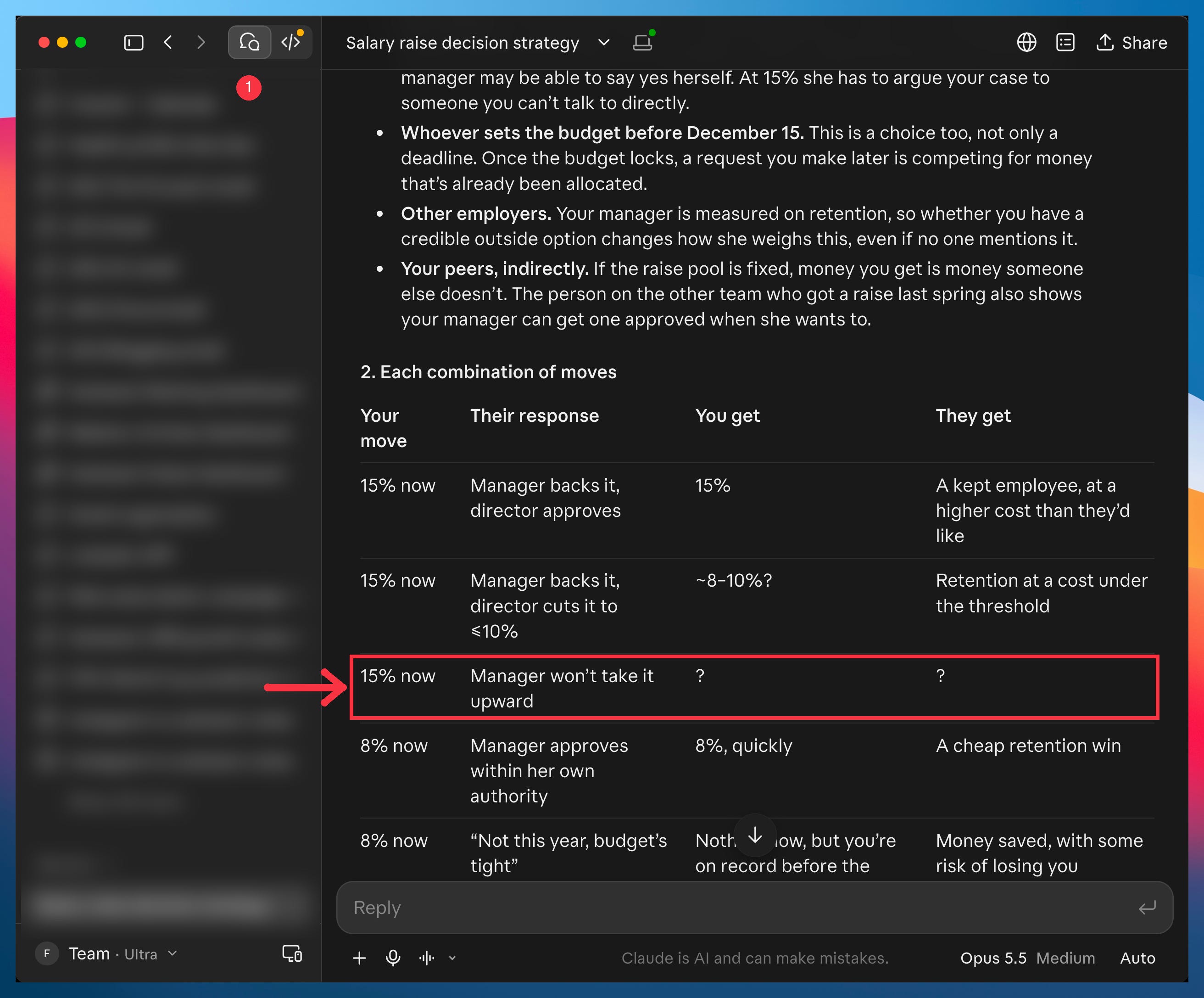
Cross off the move that loses whatever they do
Before you think about what the other side will do, check whether it matters.
Often one of your options loses no matter what they pick, and you can cross it off without guessing anything about them. Once in a while one option wins no matter what they pick, and then you can stop guessing entirely.
How to find it
Pick one thing they might do, and assume that’s what happens.
Choose your best move for that case.
Do the same for each of their other answers.
Cross off any move that’s never the best.
If the same move comes out best every time, that’s your move. If not, you’ve still cut one option, and what’s left usually comes down to when you act.
Here’s the check on the raise. Your manager has three answers, and you take them one at a time:
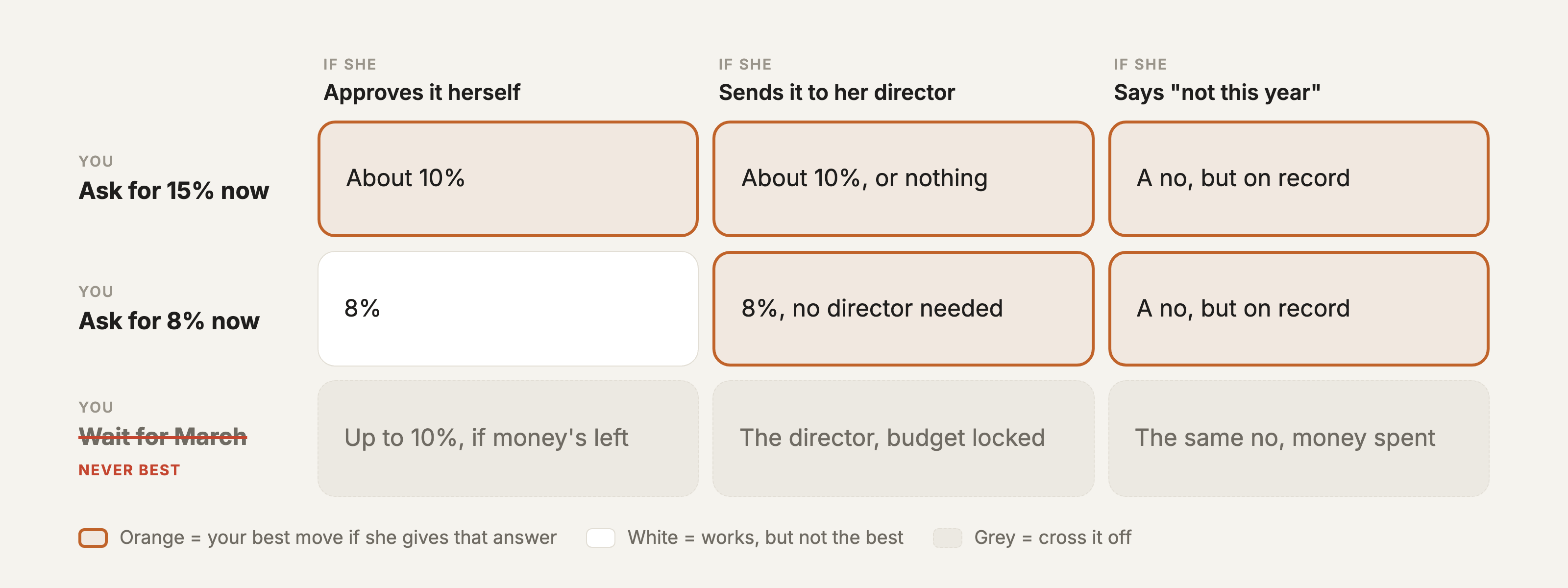
15% is never worse, but it only clearly wins when she approves it herself. So no move wins outright. But waiting never wins once, as long as March raises come out of the budget that locks on December 15, so you can cross it off. You’re left with 15% or 8% now.
Claude can run the same check on your own table. Here’s the prompt:
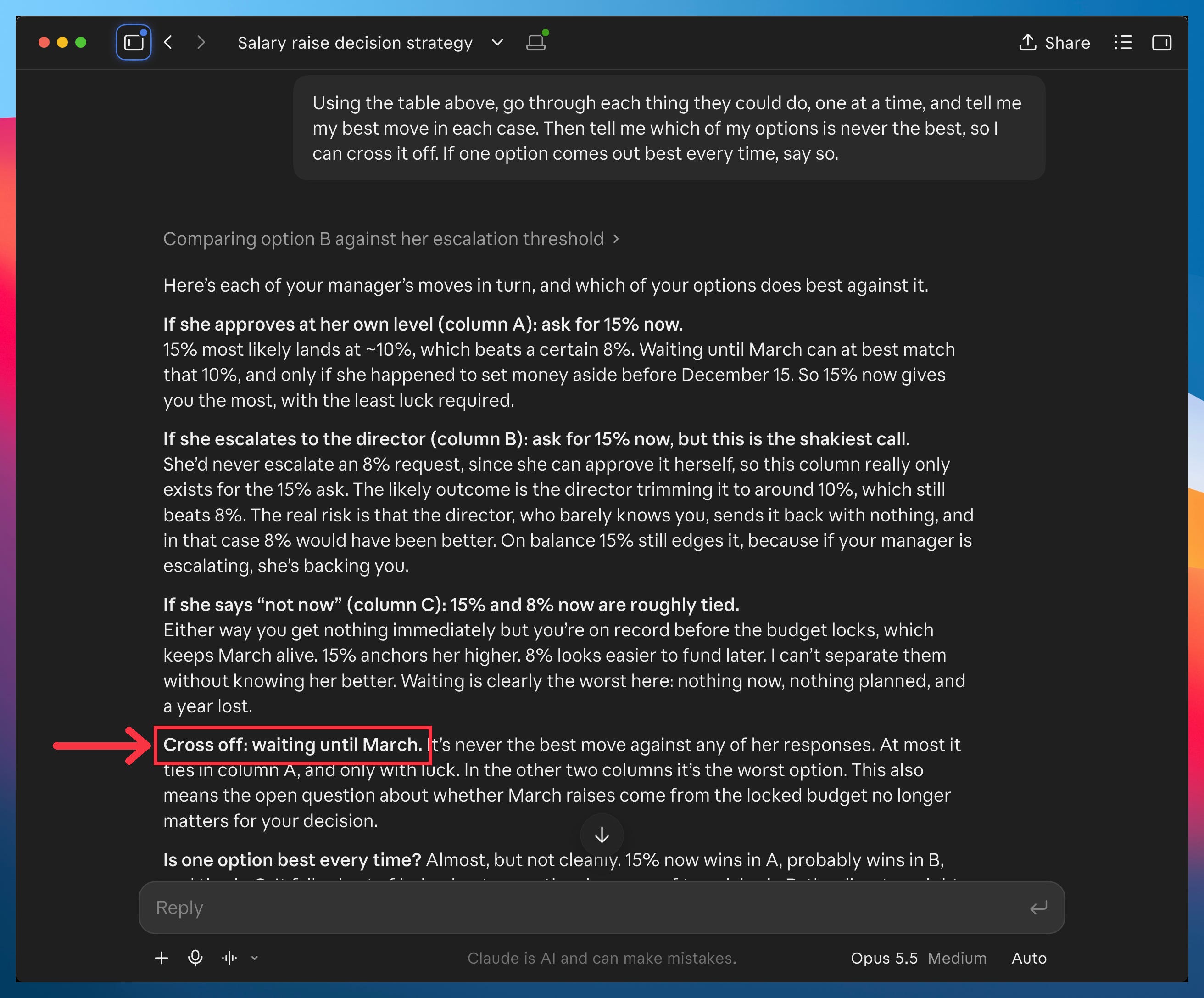
Using the table above, go through each thing they could do, one at a time, and tell me my best move in each case. Then tell me which of my options is never the best, so I can cross it off. If one option comes out best every time, say so.
On the raise, it names the same move to cross off:
When the decision is about timing, work backwards
The raise is down to two moves: 15% or 8%. The calendar decides between them. 15% needs her director, so it has to reach him with time to spare before the budget locks on December 15. 8% she can approve herself, so it stays open longer, though it gets harder once she’s sent her team’s numbers up.
Most decisions at work end up here: a renewal you could sign now or in March, an offer you could accept today or sit on, or a competitor you know is about to move. Polak calls the fix the most important thing in his game theory course: work backwards.
Work backwards from the last move
Find the last moment anyone can still act, and name it: the renewal date, the day the role gets filled, the end of the quarter.
Say what you’d do if you arrived at that moment with the decision still open.
Step back one move at a time, asking at each step what they’ll have done by then, and what that makes your best move.
Here’s what that looks like on a raise you want before next year’s budget is locked:
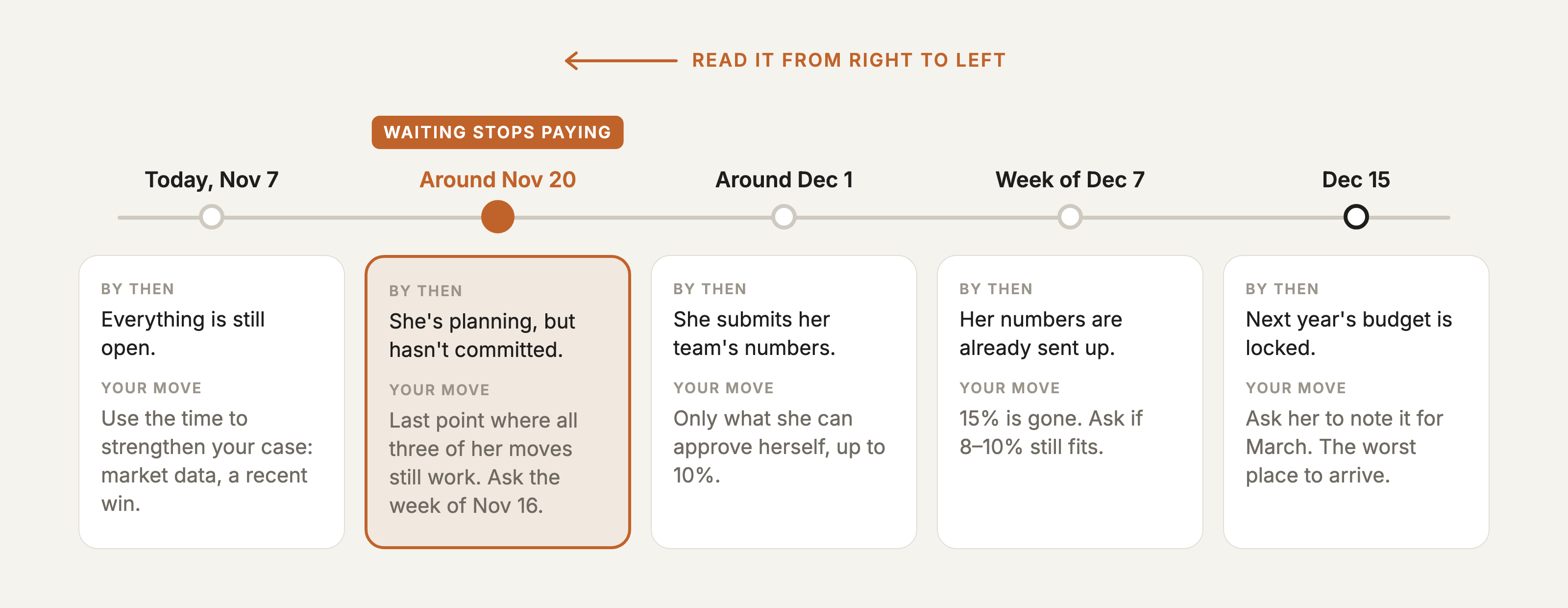
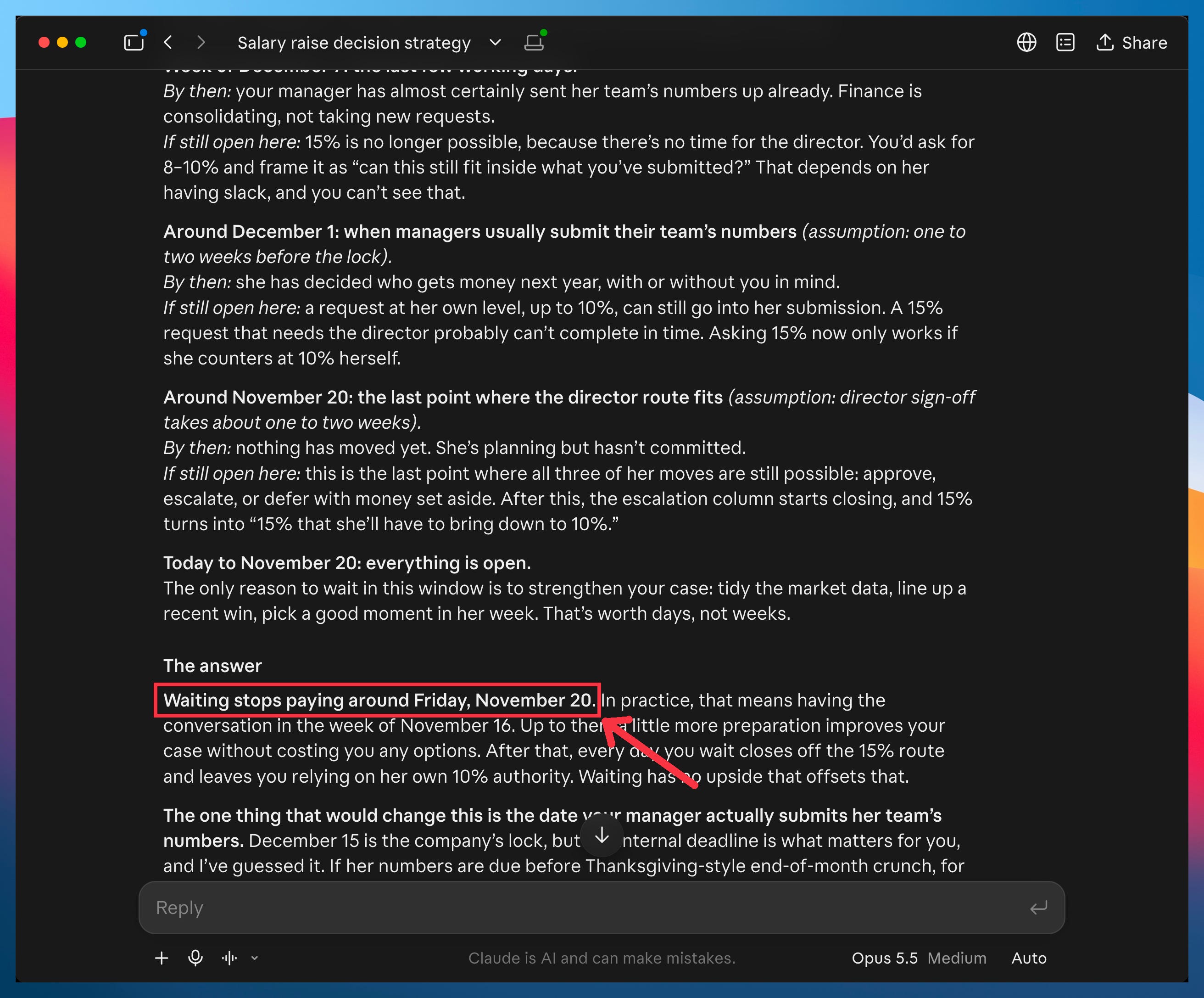
Keep going until you reach today. The first point where waiting stops paying you is your answer.
So ask for 15% the week of November 16, while she can still take it to her director. Miss that week, and 15% is too late, because the director needs time to sign off. You can still ask for what she can approve herself, up to 10%, as long as it’s before she sends her team’s numbers, around December 1 on the timeline.
Claude can walk it back for you. Here’s a template you can fill in:
Work my decision backwards. The last moment anyone can act is [the date or event]. Start there, say what I’d do if I got there with this still open, then step back one move at a time to today, saying at each step what they’ll have done by then.
Give me the earliest date or event where waiting stops paying me, and name the one thing that would change that answer.
On the raise, the last moment is December 15, when next year’s budget gets locked. Claude walks back from there and lands on November 20:
The Claude skill that puts you in their shoes
Everything so far looks at the raise from your side: your moves, your table, your date. Polak keeps coming back to the other side:
“One of the things we think about in game theory is how to put yourself in the shoes of other people.”
Your manager has a table of her own. She’s measured on keeping people from leaving, her budget is tight, and anything above 10% costs her a conversation with her director. What she says depends on how your ask looks from her seat.
The rest of this guide is for paid subscribers. It’s the skill I built to show you what the other person is likely to do, and why, before you make your move.
Below the line:
The game-theory skill: it runs this whole guide on any decision, from the first table to the date.
Their side of the table: which answer they’re most likely to give, and the one change to your ask that makes the answer you want their best answer too.
Polak’s “what if they’re not thinking it through” check: which part of your plan still holds if they don’t think it through, and which part doesn’t.
Past this line, the full skill is waiting: