

Click here to get my FREE Claude course (20+ lessons)
You’ve probably done this before.
You write a careful email. You explain the background, give your reasons, and save your answer for the end. Then the reply comes back asking the one thing you already answered, in the third paragraph.
Most people never make it to the third paragraph.
McKinsey has a fix for this: the answer goes first, then the reasons, then the details. Asking Claude to “improve” your email won’t get you there on its own.
So I turned McKinsey’s rule into a Claude skill and tested it on real emails from my inbox, from asking for a better deal to approving a contract with changes. Now Claude follows the framework on every email: answer, reasons, details (and it still sounds like me). It works the same on the emails you write every week: a status update, a reply to your boss, a request for a decision.
In this guide, you’ll learn:
Why your emails bury the point (and why asking Claude to improve them doesn’t help)
The Pyramid Principle, the writing framework McKinsey teaches its consultants
The prompt that rewrites any email using the framework
The skill that makes Claude follow the framework, in your own voice
Before and after: my real emails, rewritten by the skill
Ways to use it, plus ideas for the emails people put off
Two things before we start:
1. Save this guide, and run the prompt in section 3 on the next email you send.
2. Send it to a colleague whose emails you have to read twice.
PS: This newsletter grows mostly from people like you sharing it. Every share helps me keep writing guides like this one.
Why your emails bury the point
We write in the order we think: first the context, then the reasons, and the answer comes last.
The reader goes the other way.
They decide in the first two lines whether to keep reading, and the answer is the one thing they came for.
By default, Claude won’t fix this for you.
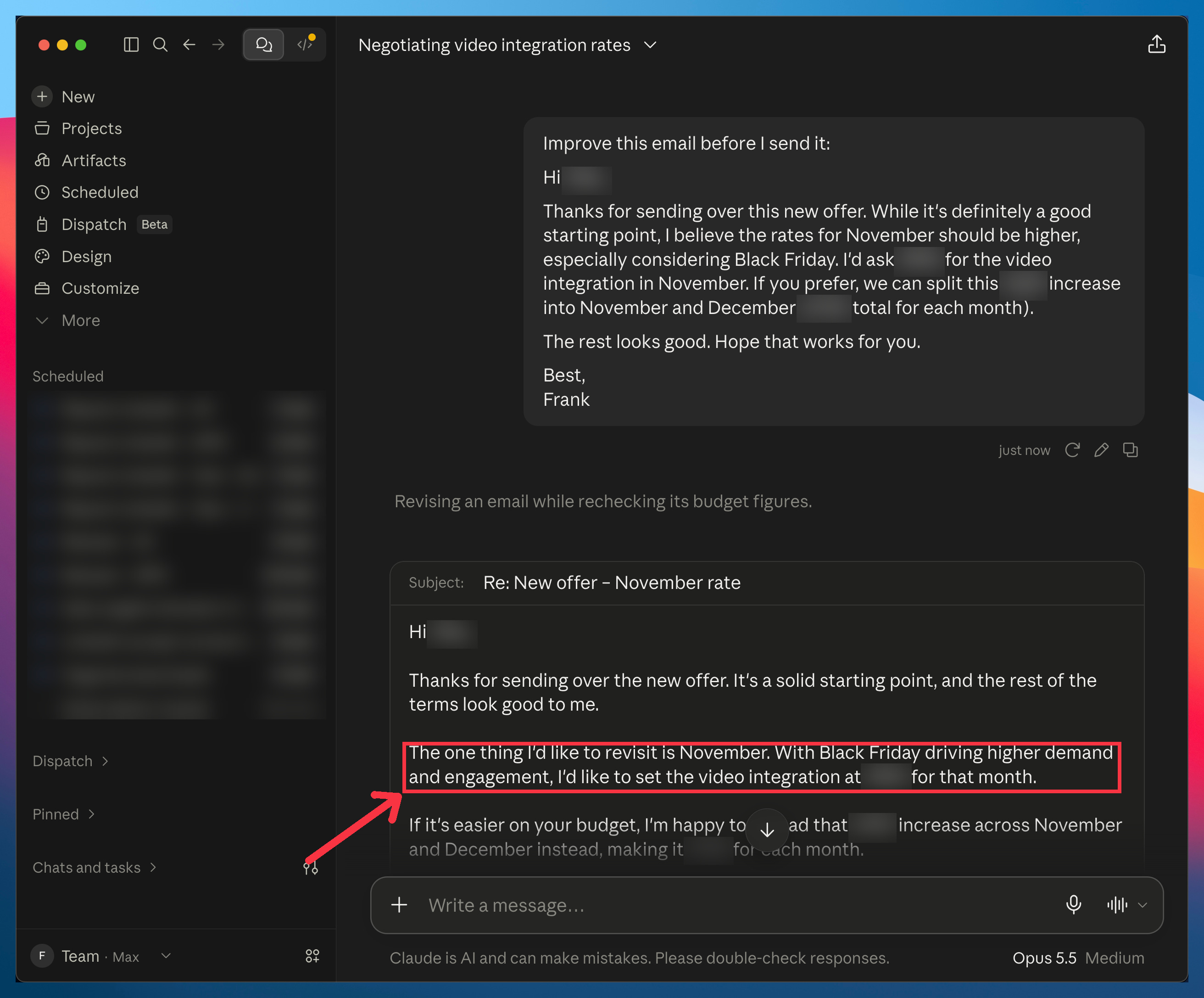
I gave it one of my real emails, where I asked a sponsor for more money, and typed “Improve this email before I send it.” It swapped a few words and added a reason for my price. But my ask stayed in the second paragraph, right where I’d buried it. It only polished the words and kept my order:
What the email needed was a different order. McKinsey has a name for it.
The Pyramid Principle
Barbara Minto, a former McKinsey consultant, wrote a rule for ordering ideas. It became a course the firm still teaches to new consultants.
It’s called the Pyramid Principle, and it fits in three lines:
The answer: your key message, what you want the reader to know or do.
The reasons: usually three, why the answer is right.
The evidence: the numbers, details and examples under each reason.
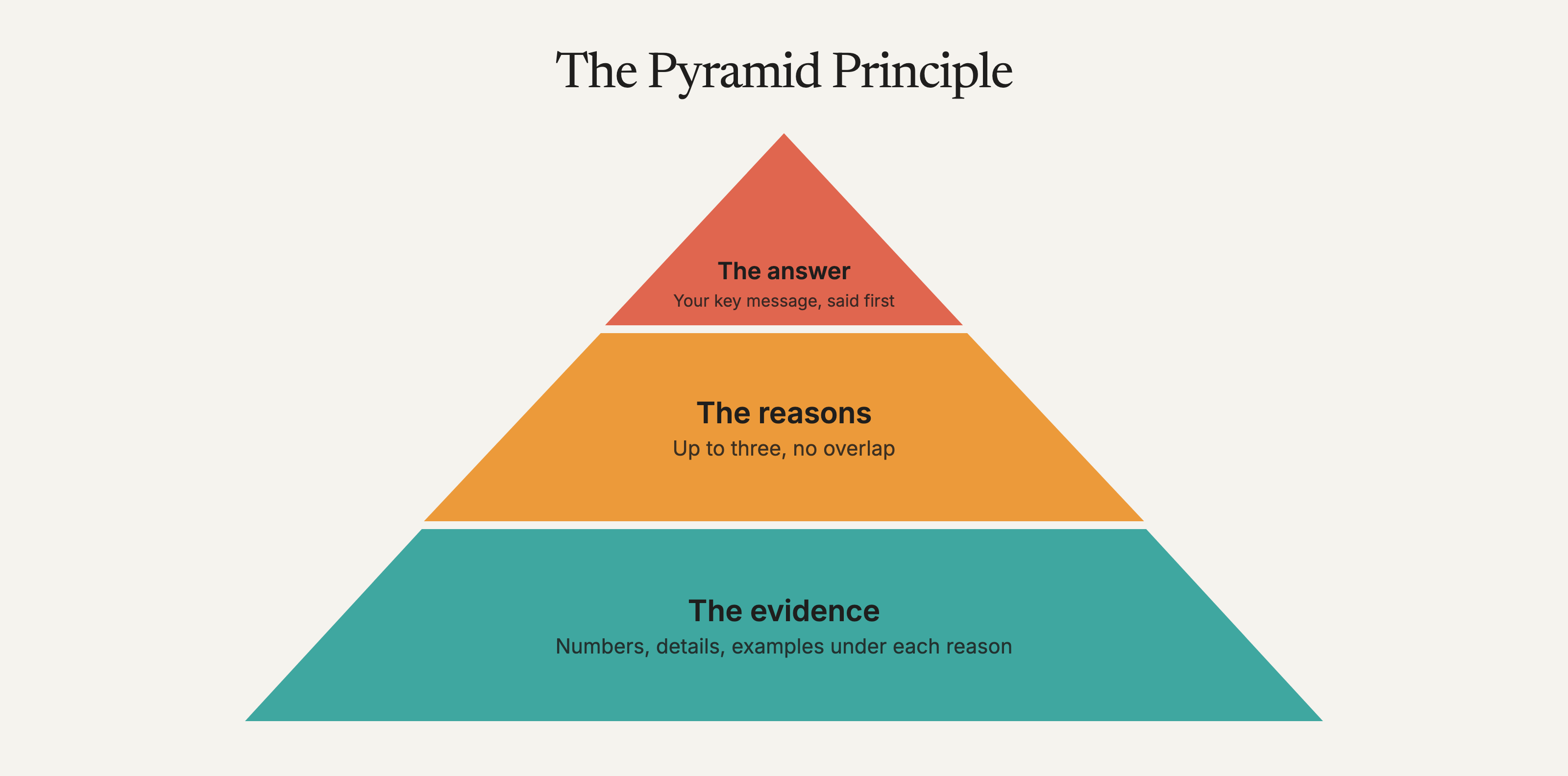
There’s one test for the reasons. They don’t overlap, and nothing important is left out. If a fourth point keeps fighting to get in, it’s usually evidence under one of the three.
For longer pieces, like a report or a proposal, Minto adds a short opening before the answer: where things stand, what changed, and the question that raises. Then the answer.
Prompt #1: Try it on an email you already sent
Open the last long email you sent, and paste it into Claude with this prompt:
Rewrite this email so the answer comes first, using Barbara Minto’s Pyramid Principle. The first sentence after the greeting says what I want [the reader] to know or do. Then up to three reasons that don’t overlap, then the details. Keep my numbers and my offer. Reword sentences so they read naturally in the new order. If the email is three sentences or less, only move the answer to the front. After the email, add one line saying what you moved.
[paste your email]
Here’s what it did to the same email from section 1:
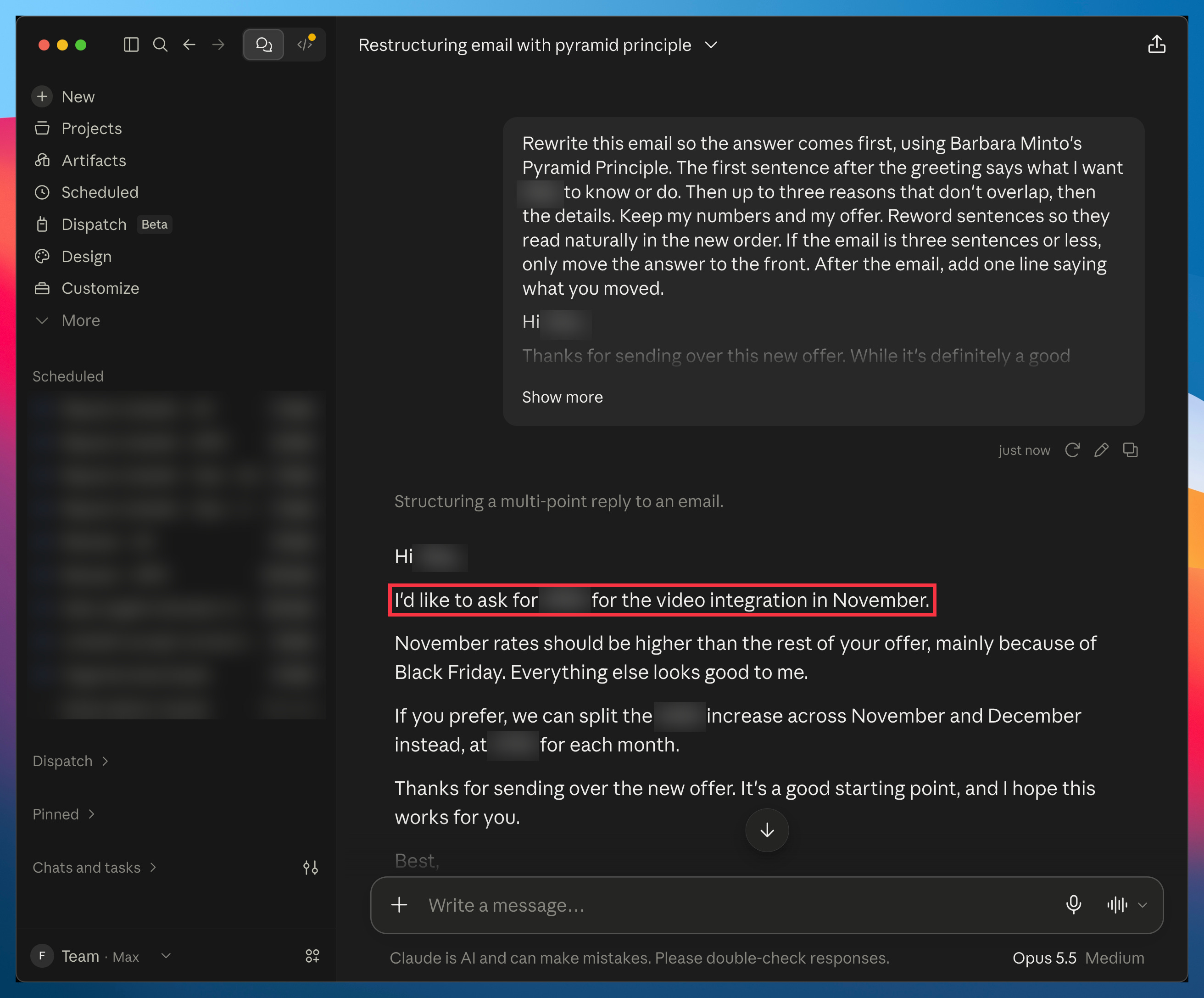
It works. The problem is you have to remember to paste it, and you’ll forget on the email that matters most.
Prompt #2: Draft a quick reply
Reply to this email using Barbara Minto's Pyramid Principle. Answer what the sender asked in the first sentence after the greeting. Add a reason only if it's needed, and keep it to a few lines. Thanks and context go after the answer, never first. If it's a no, say it first, with one word of warmth. Use my [voice file] for the words and tone.
My answer: [your answer]
Prompt #3: Draft a longer reply, update or request
Write [a reply / an update / a request] using Barbara Minto's Pyramid Principle. Put [your main point] in the first sentence after the greeting. Then these reasons, with no overlap: [reason 1], [reason 2]. End with [the details or the next step]. Use only the facts and numbers I gave you, exactly as written.
Use my [voice file] for the words and tone
Pro tip: In case you don’t want to copy-paste the prompts every time, use the skill I created. With the skill, you’ll only have to type:
/pyramid-writer
How I made Claude write this way every time
A prompt only works when you remember it. I wanted Claude to write answer-first without being asked.
So I turned the pyramid into a skill.
The rest of this guide is for paid subscribers. It’s the exact skill I built and tested, so you can copy it instead of building it from scratch.
Below the line:
The Pyramid Writer skill: set it up once, and Claude follows the framework without you pasting the prompt every time.
McKinsey’s order, your words: the skill reads your voice file, so the structure is Minto’s and the words are still yours.
A real email, before and after: my real emails, rewritten by the skill.
Past this line, the full skill is waiting: