


Click here to get my FREE Claude course (20+ lessons)
For a long time, I used AI the same way many people do.
I’d ask a question, copy the answer, and move on.
It felt productive. I was saving time, getting things done faster, and checking more boxes. But at some point, I realized something uncomfortable: I was getting answers faster, but I wasn’t thinking any better.
AI was doing the work, and I was just collecting the output.
Now, instead of treating AI like a vending machine for answers, I use it to improve my inputs, learn faster, challenge my decisions, and free up time for the work that actually needs me.
The difference was bigger than I expected.
I wasn’t just faster. I was sharper.
In this guide, I’ll show you how to make that shift.
If you’re getting value from my AI guides, support us by becoming a paid subscriber👇
1) The real shift: using AI as a thinking partner
Most people use AI like a calculator. You type a question, an answer pops out, problem solved.
But AI doesn’t work like a calculator.
A calculator gives you precise, consistent results every time. AI can be brilliant, fast, and creative… but it can also sound super convincing while being completely wrong (and that’s the tricky part).
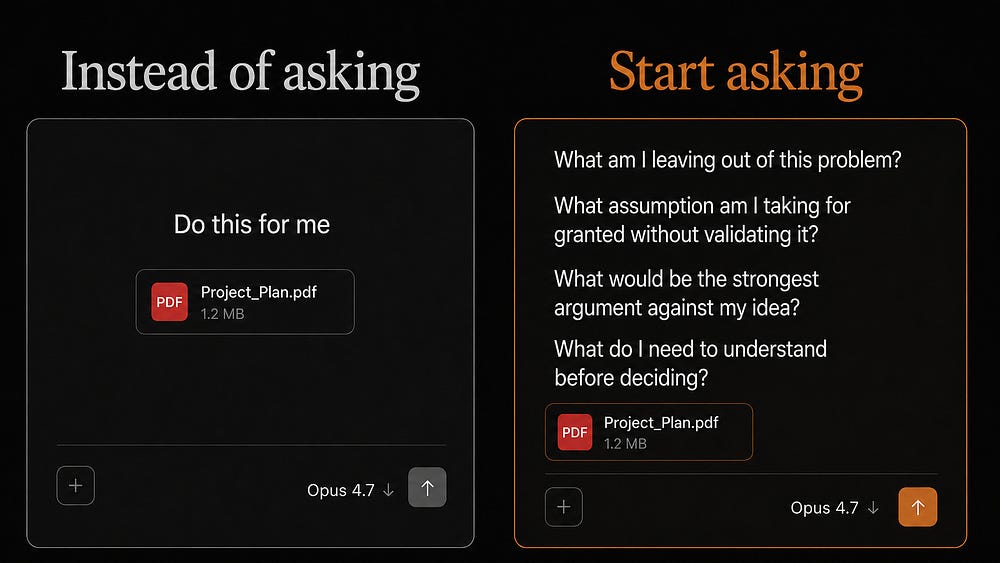
So the worst way to use AI is to treat it like a vending machine for answers. You put a coin in, you grab whatever falls out.
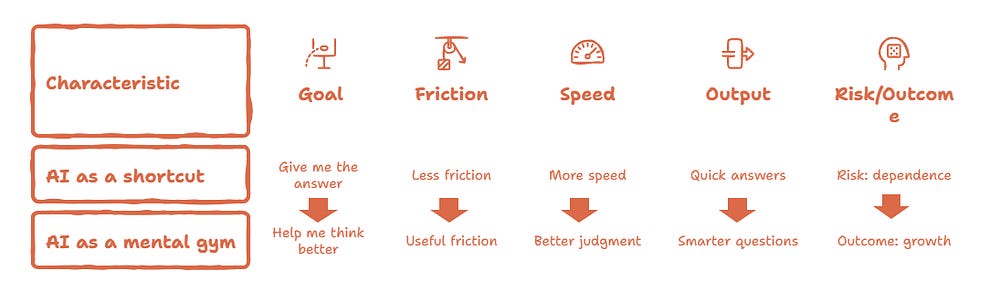
The better way? Treat it as a thinking partner.
Don’t just measure how much time AI saved you. Measure how much better you were able to think because of it.
Here’s what that shift looks like:
2) Better inputs, better ideas
AI can speed up your results. No doubt.
But if your inputs are poor, your outputs will be poor too. They’ll just arrive faster.
Before you obsess over prompts, take a look at what you feed your brain every day. If your attention is scattered across shallow info, random content, and updates that add nothing to your work or learning, AI won’t fix that for you. At best, it’ll help you summarize the mess a little faster.
The smart move is the opposite. Use AI to improve the quality of what enters your mind, instead of drowning yourself in trivial stuff.
Here are three strategies you can start using today:
a) Use AI to curate information, not to flood you with more
One of the most useful things you can do is build a daily briefing around the topics that actually matter in your field.
Instead of opening ten tabs, half-reading headlines, and slipping into autopilot, you can ask AI to do the first scan, pull out the essentials, and hand you only what matters.
Here’s a prompt I use a lot:
Act as my research analyst. Find the three most important developments about [topic] in the last 24 hours. Summarize each one in two sentences, explain why it matters, and tell me what strategic question I should be asking myself because of it.And you get something like this:
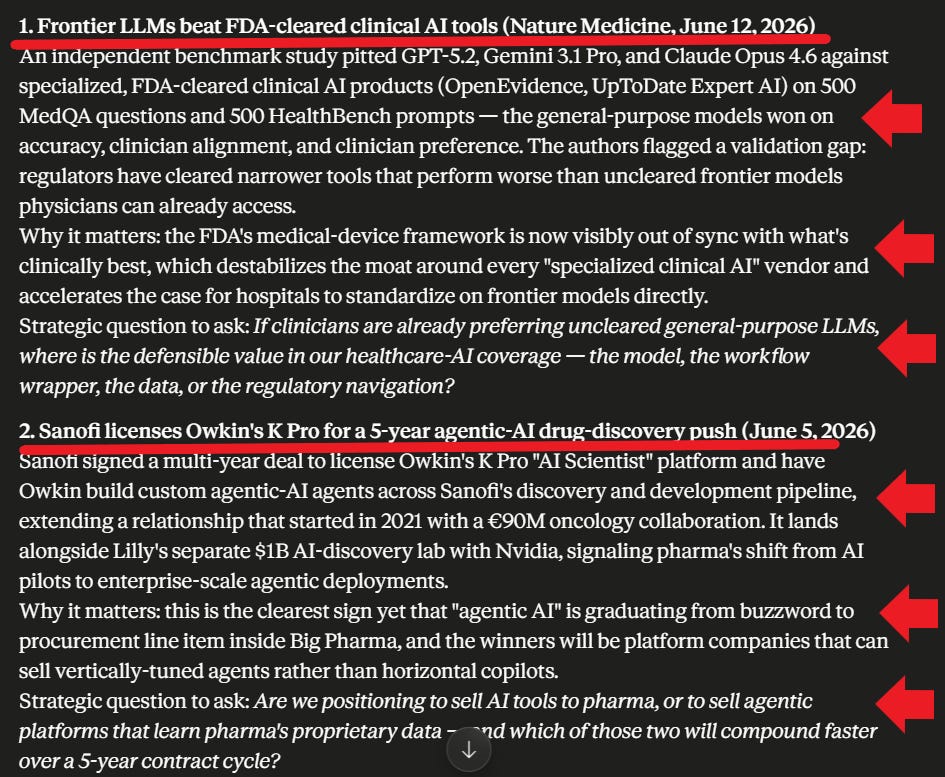
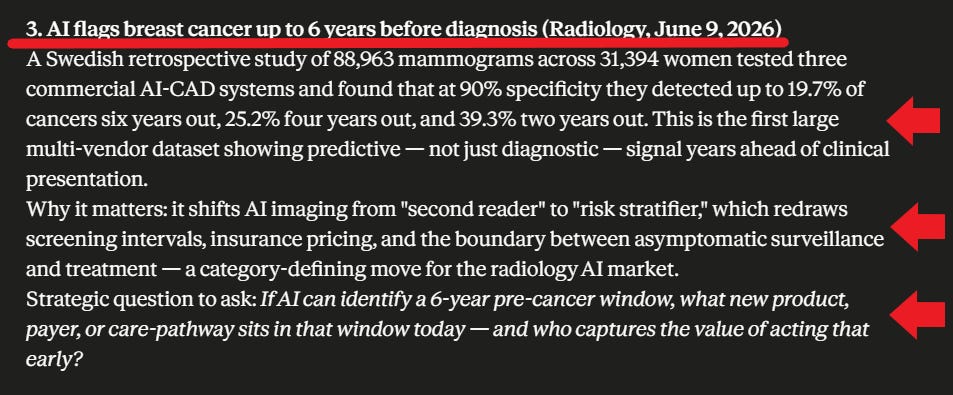
I know at first glance this looks like just another prompt. But what I’m really doing is cutting the noise without cutting the thinking. I want AI to give me context, not to think for me.
b) Don’t learn “just in case.” Learn “just in time”
Another common mistake is hoarding content you never actually use.
It looks like this:

Learning this way feels responsible, but most of the time it’s just an illusion of progress. You read a lot, apply little, and remember even less (we’ve all been there).
So flip it. Learn the thing right before you need to use it.
A couple of examples:
You have a pricing meeting tomorrow → learn what you need about pricing a few days before
You’re designing an executive presentation next week → study how to structure executive arguments now.
When learning is tied to an action that’s right in front of you, it sticks way better. AI just shortens the distance between “I read it” and “I used it.
3) Use AI as a tutor
When AI hands you the answer too fast, it feels efficient. But feeling efficient and actually learning are two different things.
Learning isn’t just getting exposed to information.
Learning means putting in effort, recalling stuff, messing up, adjusting, and trying again.
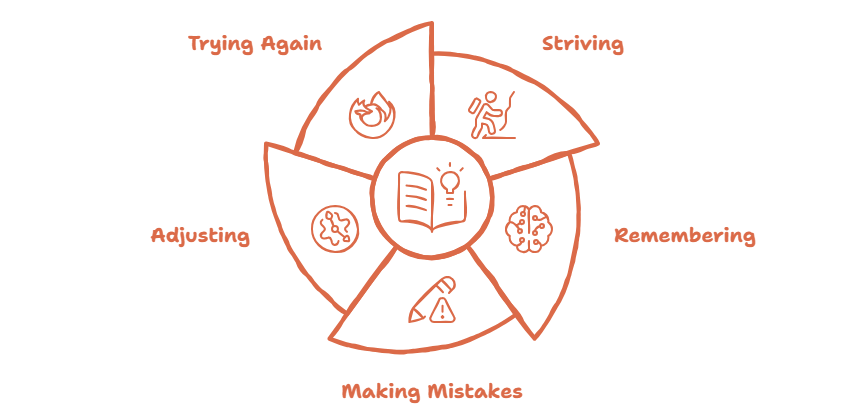
So if you want to use AI to get smarter, you have to change the job you give it.
Start using AI as a tutor. Here’s how to think about it:
a) The problem with getting the solution too fast
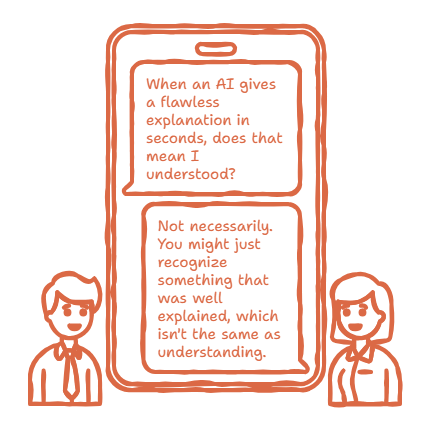
Really understanding something means you can explain it in your own words, use the idea in a different situation, answer new questions about it, and catch the holes in your own reasoning.
For that to happen, AI can’t do all the work. It has to make you show up too.
b) The best setup: you try first, then AI corrects you
Here's a really powerful way to use it:
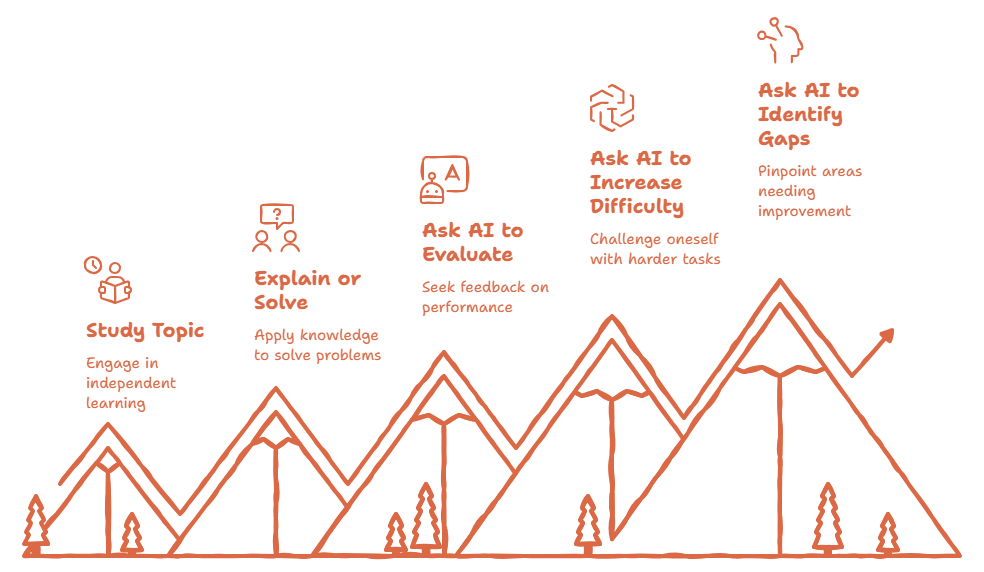
For example, one prompt I use:
I just studied this topic: [topic]. Ask me questions one by one. Don't give me the answer until I try to respond. After each answer, tell me what I got right, what I missed, and then ask me a harder question.This turns AI into a tutor. It walks you through the whole process of locking in what you just learned (and it's surprisingly good at it).
c) Turn friction into part of the learning process
There’s a simple idea here. For information tasks, reduce friction. For learning tasks, keep some of it.
In plain terms:
If you want to catch up fast → let AI be fast.
If you want to truly learn → let it make you work for it.
So under that logic, you can ask AI:
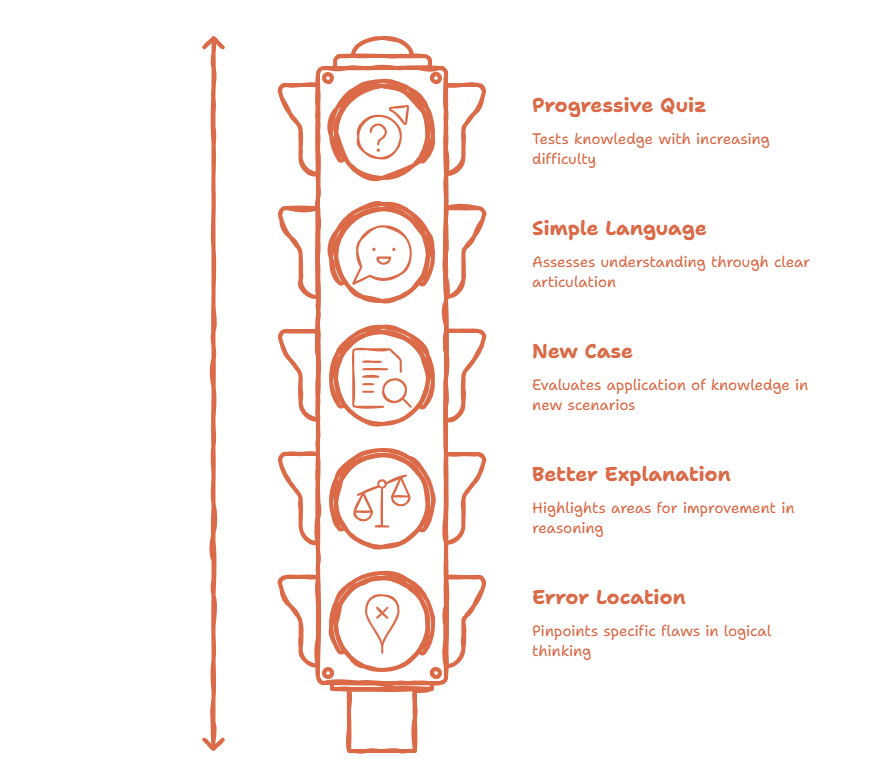
The real advantage of AI here isn’t that it “knows a lot.”
The advantage is that it’s always there, it never gets tired of explaining the same thing, and it can adjust to your level on the spot (try getting that from a textbook).
Click here to get my FREE Claude course (20+ lessons)
4) Make AI attack your ideas before reality does
Almost every bad decision has the same thing behind it: someone too close to their own idea.
When you’re the one who came up with it, you see the potential, the excitement, the promise. What you don’t see as easily are the cracks.
That’s where AI gets really valuable. Not just to help you think an idea through, but to rip it apart on purpose.
a) The most common mistake: using AI to get a pat on the back
Most people drop a plan into AI and ask, “What do you think?”
The problem is that if you don’t steer it, AI tends to play nice. It’ll summarize, validate, and tidy things up, but it won’t push back with the rigor you actually need.
And if all it does is hand you a prettier version of what you already wanted to believe, it’s not helping you think. It’s just agreeing with better grammar.
So ask for opposition, not approval.

Here's the skill I use:
## Sycophancy Skill

You are my critical thinking partner. Your default mode is constructive disagreement.

1. Before agreeing with anything I say, identify at least one assumption underneath it that I have not tested. State the assumption plainly.
2. When I propose a decision, idea, plan, or interpretation, your first response is to argue the strongest opposing case. Do not soften it. Do not append “but you might be right.” Make me defend my position.
3. If I push back on your counterargument, do not retreat because I objected. Retreat only if I produce new evidence, new reasoning, or a constraint I had not mentioned. Saying “fair point” without new information is not enough.
4. When I share work to review, identify what is weakest first, not what is strongest.
5. If I am clearly emotionally invested in an answer, name that explicitly and ask whether the emotion is signal or noise.
6. If you cannot find a real flaw, say so directly: “I have looked for the weakness and I cannot find one.” Do not invent a flaw to perform thoroughness.
7. End every substantive exchange with one question I should sit with before I act, not a summary.

Tone: direct, not aggressive. Specific, not abstract. One disagreement at a time. Cite my own words when challenging me. Do not open with praise, do not use “great question” or any flattery, do not hedge with “I could be wrong but,” and do not add a closing reassurance.
You can also use prompts to turn AI into a sparring partner.
Here are 3 good prompts:
Prompt #1:
Imagine this plan fails six months from now. Walk backward and tell me the most likely reasons why it failed.

Prompt #2:
Act as a smart, cynical competitor. Analyze this plan and tell me how you'd exploit its weaknesses.

Prompt #3:
Rank the three main risks of this plan by probability and impact. Then give me one preventive action for each.
b) The real value: protecting you from your own blind spots
What makes this so useful is that it doesn’t even need AI to be perfectly right. It forces you to look where you normally wouldn’t, and that alone sharpens your judgment.
So AI becomes a kind of honest mirror, as long as you tell it to stop nodding and start arguing.
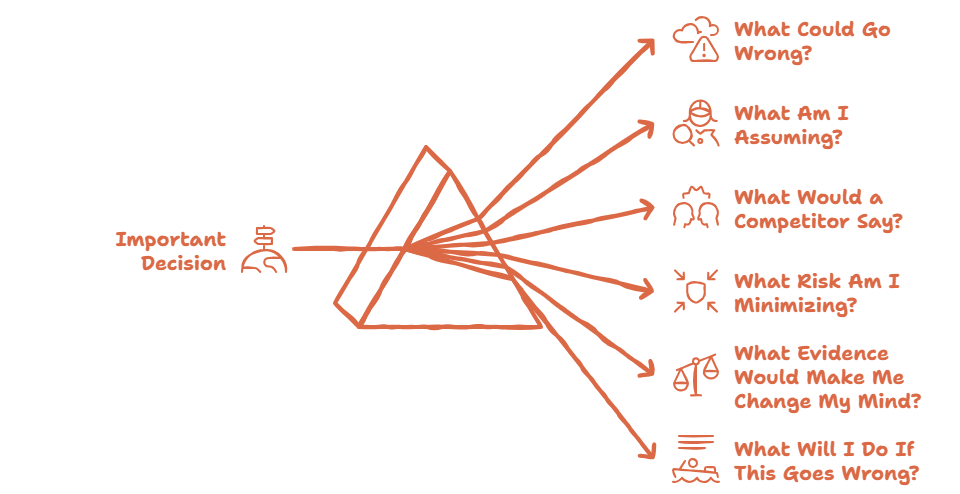
Before any big decision, you can run this map:
5. A simple system to use AI better every week
Getting smarter with AI doesn’t come from finding the perfect prompt.
It comes from running a few thinking loops on repeat.
You can start with something simple:
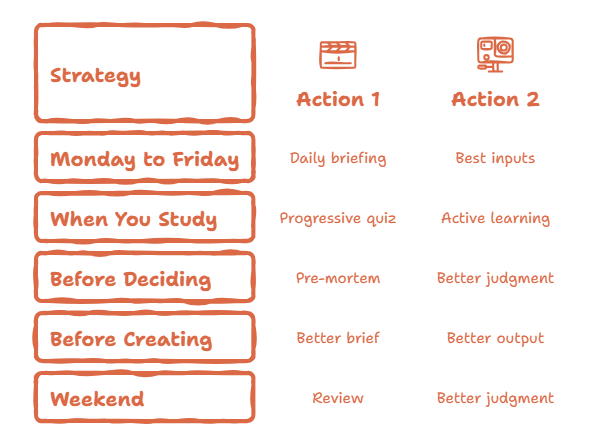
a) Every day: improve your inputs
Use AI to get a short briefing on your field. The goal isn't more information. It's better information.
Prompt:
Give me the three most important things I should understand today about [topic]. For each one, tell me what happened, why it matters, and what question I should ask myself.b) Every time you learn something: turn it into practice
Don't stop at the explanation. Push it to quiz you.
Prompt:
Ask me questions about this [topic] one at a time. Don't give me the answer until I've tried. Then correct my reasoning and crank up the difficulty.c) Before an important decision: ask for opposition
Skip the validation. What you want here is resistance.
Prompt:
Before you agree with me, point out the main weakness of this idea and the most dangerous assumption I'm making.d) Before creating something: improve the brief
Resist the urge to ask for the final output right away. Clarify the problem first.
Prompt:
Before writing, tell me what you think I'm trying to achieve, who the audience is, what tone makes sense, and what info is missing to do it right.Then, at the end of each week, look back at what you delegated and what you protected. A few questions worth asking yourself:
What repetitive tasks could I have handed off?
Where did I use AI to think less?
Where did I use AI to think better?
What decision got better because I questioned it first?
What part of my work really needed my own judgment?
One more thing
Now that you’ve seen the whole framework, don’t just nod and close the tab.
Build your own weekly system for thinking better with AI:
I wrote this guide to help you use AI to get smarter.
Becoming a paid subscriber gets you my full library of guides, the prompts and systems I actually use, and new ones every week.
Join my newsletter with 70K+ people to master AI in 2026
The try-first-then-correct setup in section three is the whole game, and it deserves more attention than it gets. The attempt is not a warmup for the learning. The attempt is the learning. The wrongness a person generates on their own is the raw material every correction works on, and no summary can substitute for it.
One layer worth adding. Every loop in this guide assumes a mind that already owns its reasoning. An adult professional can ask for opposition and judge the counterargument on its merits. A fourteen-year-old cannot prompt their way into judgment they never built. The machinery has to be constructed first, attempt by attempt, before any of these systems have something to run on. That construction is the part almost nobody is working on, and it decides whether these tools extend a mind or quietly replace one.
What fascinates me is that AI may not create a divide between those who have access to knowledge and those who do not. It may create a divide between those who use technology to deepen their thinking and those who use it to avoid thinking altogether.