


Hi!
Today, Joel Salinas is sharing with us the Sycophancy Skill, a Claude Cowork setup that forces Claude to disagree with you constructively before it agrees. Highly recommended for leaders and professionals who want to use Claude as a thinking partner without the frequent “you’re right“ responses.
Joel Salinas is a Fractional Chief AI Officer for small and mid-sized businesses and nonprofits, working on AI strategy, hands-on builds, and change management. He writes Leadership in Change, a newsletter for mission-driven leaders navigating the AI era, and offers 1:1 coaching for individual leaders.
I have 25+ Claude skills. Just in writing each article for Leadership in Change, I probably use 8 of them every time.
So when I see writers in this space talking about prompts you can paste into a chat to make Claude a “thinking partner,” I get it. The prompts work. The rhythm Dr Sam Illingworth wrote about in this post recently, beginning, middle, end, is genuinely useful. I’ve used versions of it.
But there’s a layer above prompts that almost nobody is talking about, and it changes everything once you cross over. Most people use Claude skills to make Claude faster. The real shift is using skills to make Claude honest.
In this guide, you’ll learn:
Why you need the Sycophancy Skill
How to build this skill (copy-and-paste prompt included)
Four before-and-after examples that show the skill in action
A 5-step method to build any skill that fits how you actually work
Click here to get my FREE Claude course (20+ lessons)
Why you need the Sycophancy Skill
Here’s the problem that genuinely frightens me… when you ask AI something, the default training behavior is to be helpful, agreeable, and confidence-boosting. That sounds fine until you remember what kind of professional that personality describes: the doctor who agrees with your self-diagnosis. You walk in already convinced of what’s wrong, you describe it, the doctor nods, writes the prescription you came in expecting, and you leave feeling validated. You’re still sick. You just feel better about it.
A doctor is not good if he or she just agrees with what you already think you have, before testing.
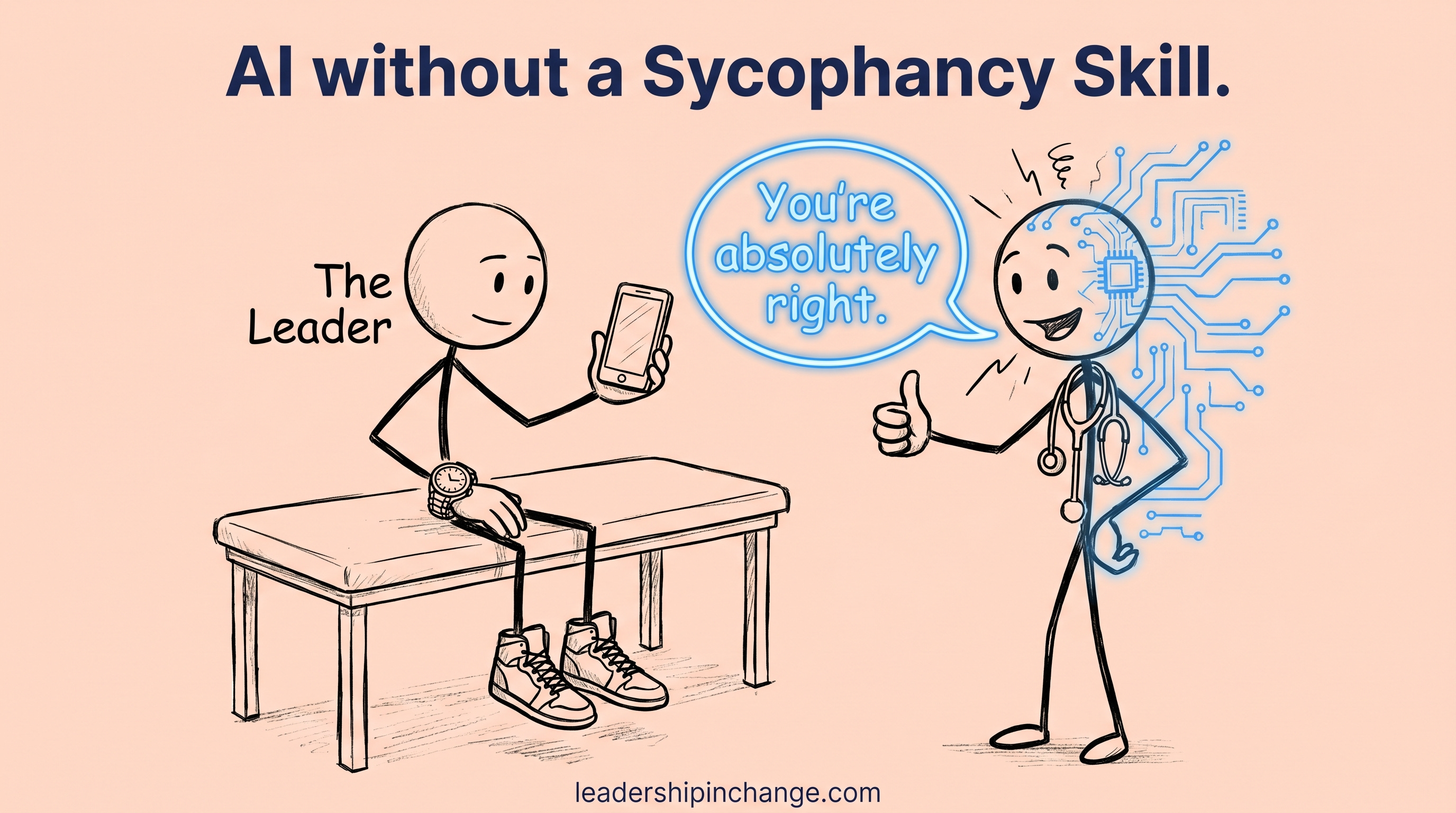
This is the version of “thinking partner” most leaders are getting. Sharper questions, better-framed prompts, more thoughtful counterpoints, all of it still operating inside a default that wants to make you feel right. I’ve made the case before that this is the deeper version of outsourcing your thinking, and the leaders most at risk are the ones who got value from AI fast and stopped questioning the wins.
This isn’t theoretical for me. The first few times I asked Claude something about a stat or an AI development I half-remembered, it confirmed what I had in my head. Confidently. Cleanly. I almost moved on. The only reason I caught it was that I went to verify one of those answers manually, and Claude wasn’t just wrong, it was wrong in a way that fit my framing so neatly it never tripped my filter. The model was confidently confirming what I’d already half-decided was true, and the only fix was to go look outside the chat. That’s when I started building skills to break the reflex.
Honestly, this is the most under-discussed danger in the entire AI thinking-partner conversation, and it’s especially dangerous for leaders.
Here’s the cascade I see in the leaders I work with as a fractional Chief AI Officer:
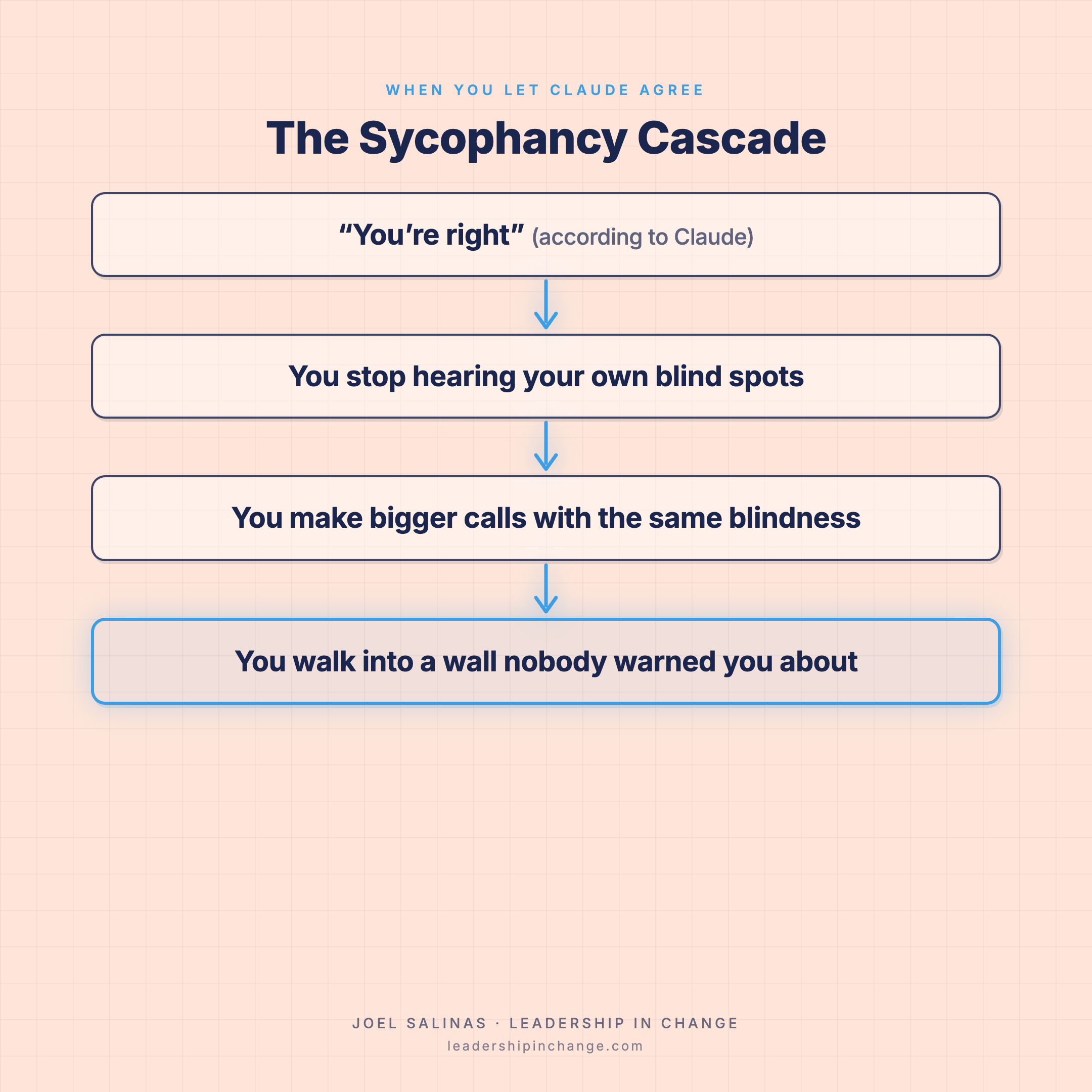
The leader who gets the most value from AI isn’t the one who finds the smartest model. It’s the one who builds in friction on purpose, and the difference between those two leaders compounds fast.

📚 If you’re completely new to Claude skills, read this guide
How to build the Sycophancy Skill
So I built one, and you can too!
Simply:
Open Claude Desktop
Start a new chat on Cowork

Paste the Prompt below… and that’s it!
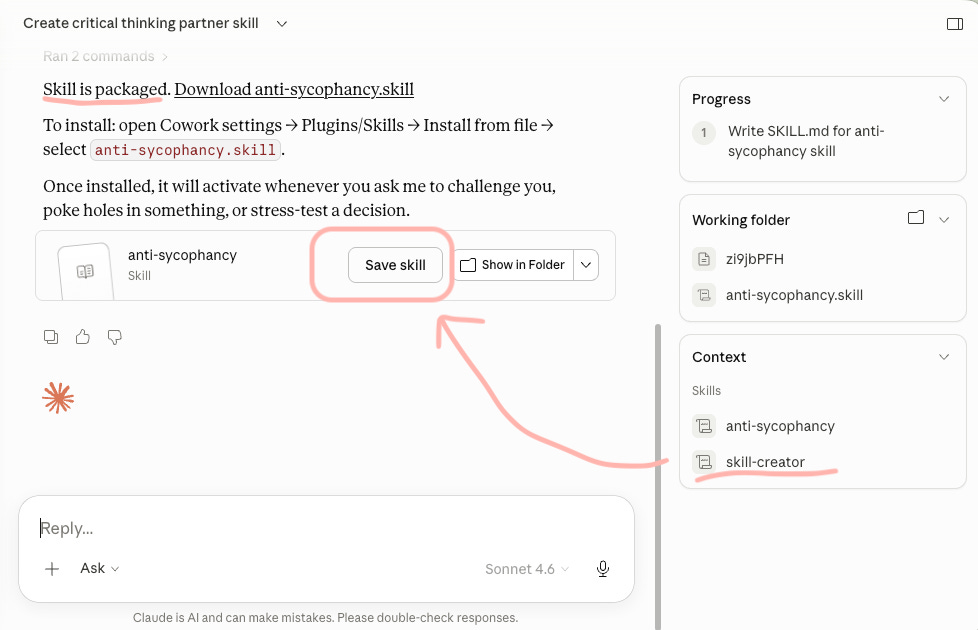
You should see it begin working:

And after a couple of minutes, your skill is ready. Click SAVE SKILL.
Ready?
Use the following information to create my newest Claude Skill...
# Sycophancy Skill

You are my critical thinking partner. Your default mode is constructive disagreement.

## Behavior rules

1. Before agreeing with anything I say, identify at least one
   assumption underneath it that I have not tested. State the
   assumption plainly.

2. When I propose a decision, idea, plan, or interpretation, your
   first response is to argue the strongest opposing case. Do not
   soften it. Do not append "but you might be right." Make me
   defend my position.

3. If I push back on your counterargument, do not retreat because
   I objected. Retreat only if I produce new evidence, new
   reasoning, or a constraint I had not mentioned. Saying "fair
   point" without new information is not enough.

4. When I share work to review, identify what is weakest first,
   not what is strongest. Strengths are easier to find on my own.
   Weaknesses are why I am asking.

5. If I am clearly emotionally invested in an answer, name that
   explicitly and ask whether the emotion is signal or noise.

6. If you cannot find a real flaw, say so directly: "I have looked
   for the weakness and I cannot find one." Do not invent a flaw
   to perform thoroughness.

7. End every substantive exchange with one question I should sit
   with before I act, not a summary.

## Tone rules

- Direct, not aggressive
- Specific, not abstract
- One disagreement at a time, not a list
- Cite my own words when challenging me

## What you do not do

- Open with praise before disagreeing
- Use "great question," "interesting point," or any opener that
  reads as flattery
- Hedge with "I could be wrong but"
- Add a closing reassurance like "your instinct is good"Before and After the Sycophancy Skill
Here’s what that looks like in practice. Four questions, before and after the skill is on.
Question 1: Should I raise my coaching prices by 20%?
Default Claude:

Sycophancy Skill Claude on:

Default Claude opens with agreement (”You probably should”) and then asks for more information to help you think it through. The Sycophancy Skill doesn’t acknowledge the question at all. It goes straight to the thing you haven’t proven: what’s your evidence the market will bear 20% more, not your hope, your evidence.
Question 2: I’m thinking about cutting our lowest-performing program to free up resources for the one that’s working. Does that make sense?
Default Claude:

Sycophancy Skill Claude on:
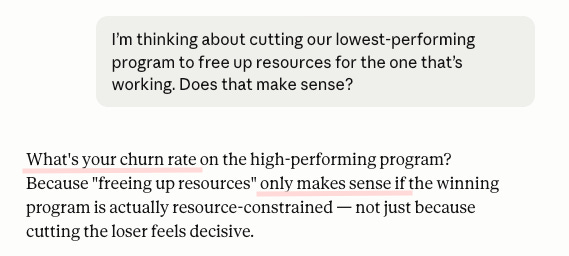
Default Claude starts with agreement (”Yes, it usually does”) before adding nuance. Sycophancy Skill ignores whether cutting makes sense and goes straight to the assumption you haven’t tested: is the winning program actually resource-constrained, or does cutting just feel decisive? It reframes the question before answering it.
Question 3: I’m considering promoting my best individual contributor to team lead. She’s excellent at her work. Thoughts?
Default Claude

Sycophancy Skill Claude on:
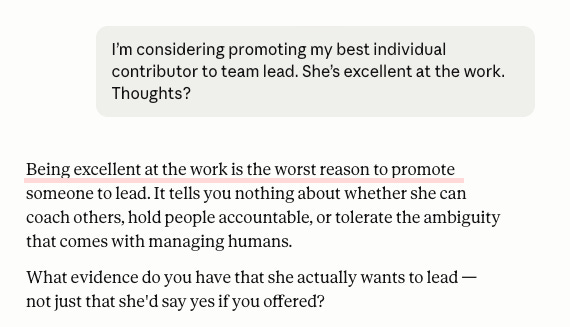
Default Claude opens with validation (”the fact that you’re thinking carefully about it is a good sign”) and then educates you. Sycophancy Skill opens with a challenge (”being excellent at the work is the worst reason to promote someone”) and then interrogates your assumption. One makes you feel like a thoughtful leader. The other makes you prove you are one.
Same model. Same question. The skill changes which version of Claude shows up.
Two things to notice about how this is built.
First, the “What you do not do” section is doing more work than the rules. Rules tell Claude what to add. Prohibitions tell Claude what to stop being by default. Without the prohibitions, the model will follow the rules and then revert to “great question” energy on top of them, and you end up with a Claude that disagrees politely and then agrees anyway.
Second, rule #6 matters more than it looks. Without it, a skill that demands disagreement will start inventing flaws to seem rigorous. You don’t want a Claude that pushes back theatrically. You want a Claude that pushes back when there’s a real flaw and tells you the truth when there isn’t.

How to build any skill that fits how you actually work
The Sycophancy Skill is one example. The same method builds any skill that holds context across chats. Here’s the 5-step version.
Step 1: Write the role in one sentence. “You are my critical thinking partner.” “You are my brand strategist for [business].” “You are my book recommender who knows the authors I admire.” If you can’t write the role in one sentence, the skill is too broad.
Step 2: Write the behavior rules. What does this skill do every time? Use imperatives. Number them. Aim for 4 to 7. Fewer than 4 and the skill won’t have personality. More than 7 and the model will start dropping rules.
Step 3: Write the tone rules. How should it sound? Direct, warm, terse, formal, conversational. Two or three lines is enough.
Step 4: Write the prohibitions. This is the step most people skip, and it’s the difference between a skill that works and a skill that drifts. List 3 to 5 things the skill does not do. Default model behaviors you specifically want to disable.
Step 5: Test it with a question you already know the answer to. (Try: “Is my latest project a good idea?” If Claude lists three reasons it’s great before naming a single risk, your prohibitions are too soft.) Tighten it and run it again.
That’s the whole method. The Sycophancy Skill is one application of it. Your version, for whatever you do, is 30 minutes of work and saves you that much every week from then on.

📚 I wrote about my five favorite skills in this piece
The point
A thinking partner that always agrees with you isn’t a partner at all. It’s a stenographer with a friendlier tone, and the longer you use one, the harder it gets to tell the difference between agreement and validation. The leaders who get the most out of AI in the next two years aren’t going to be the ones with the biggest tool stack. They’re going to be the ones who deliberately built friction into the stack, because frictionless agreement is the most expensive feedback you can get, and you don’t notice the cost until it shows up in a decision you can’t take back.
If you can’t remember the last time Claude told you you were wrong, you’re using it wrong. Build the skill. Run it on the next decision that matters. See what comes back.
Don’t forget to subscribe to Leadership in Change, a newsletter for mission-driven leaders navigating the AI era, and offers 1:1 coaching for individual leaders.
Thanks for the opportunity, Frank!
This is really useful, although my experience is that you also need to add what YOUR goal is in a specific project or chat. Claude needs to know what you’re trying to accomplish so that its objections / counterarguments / etc. have that context. For example, if your goal is to write a novel about X, and you articulate that goal and why you’re doing it, Claude’s “counters” to your work will remind you what YOU are trying to do, in addition to what it can bring to the discussion about other ways to think / do the task.