

Click here to get my FREE Claude course (20+ lessons)
Most people who want to make money with Claude start in the exact same place. They try to build an app.
They watch someone vibe-code a tool in an afternoon, think “I could sell that,” and spend the next three weekends fighting bugs for a product nobody ends up buying.
Here’s the uncomfortable part: the vast majority of vibe-coded apps never make a single sale.
The people actually paying their rent with Claude are doing something far less exciting. They sell a service, and let Claude do most of the work behind it.
You don’t need to code
You don’t need to be an AI expert
You don’t even need a brand-new idea
You need to be useful to someone who’s willing to pay.
In this guide, you’ll learn:
The one mindset shift that separates people who earn with Claude from the rest
Why a service beats an app (almost) every time
5 ways people are actually getting paid with Claude right now
How to turn a single client project into income that repeats
How to land your first clients (even starting from zero)
Consider becoming a paid subscriber to get full access to all my guides (+ these perks) 👇
You’re the CEO. Claude is Your Team
Let’s start with the mistake, because almost everyone makes it.
People treat Claude like a magic button. They expect to type one prompt, get a finished business, and watch the money roll in.
Here’s a better way to think about it.
You are the CEO. Claude is your worker.
Actually, it’s a whole team of workers. It can research, write, design, crunch numbers, and handle the boring parts of a job.
But it still needs someone with a vision telling it what to do and deciding what’s good enough to send to a client.
No amount of AI saves a bad leader. That part is still on you.
And here’s the best part:
You don’t have to be technical or an expert in AI.
The most important thing is to be good enough at what you do to tell good output from bad.
I know that sounds too good to be true, but two years ago, almost nobody knew what Claude was (I signed up and never used it!) Everyone you see teaching this stuff today (me included) started from zero a few months/years ago
At the end of the day, people don’t pay for your credentials. They pay for results. If you can deliver the result, and Claude helps you deliver it faster, you’re already in business.
Click here to get my FREE Claude course (20+ lessons)
Stop building apps. Sell a service
Before picking what to sell, let’s kill the most common bad ideas, because chasing the wrong model is how people waste months.
A good way to make money with AI should be cheap to start, have healthy margins, get you to real income relatively fast, and still work a year from now.
Unless you have thousands of followers, I wouldn’t recommend:
Vibe-coding apps: high margins on paper, but getting actual users is brutal, and someone can copy you next week.
AI dropshipping: high ad costs, thin margins, a race to the bottom.
Faceless YouTube channels: everyone uses the same tools, so nothing makes you stand out (and you’re not building anything that’s really yours).
Cheap templates: easy to make, easy for anyone else to clone
Notice the pattern? They all either cost a lot up front or are trivially easy to copy.
Now the one that quietly wins: selling a service powered by AI.
The math is simple. Startup cost is basically zero, because you sell the service first and deliver it after. Margins are high, because Claude does most of the work instead of a team of employees. And if you wrap it in a personal brand, it gets more durable over time, not less.
My rule of thumb: sell first, build later.
You’re not committing to building anything. You’re making a promise (”I can do this for you, here’s the price”) and only doing the work once someone says yes.
And please, don’t overthink your offer.
Some people spend dozens of hours agonizing over the perfect offer and pricing, then a few hours learning Claude, then almost no time actually selling.
That’s backwards.
Spend around 30 minutes on your offer. Pick something, slap a price on it, and move.
You’ll change it anyway once the market tells you what it’ll pay (you might find out you were charging too little).
If you’re staring at a blank page, use a simple fit test to decide what to sell. Look for the overlap of 3 things:
What you love doing
What you’re actually good at
What people will pay for
The sweet spot is where all 3 meet. That’s your offer.
5 ways people are getting paid with Claude
Here are the ones that work right now. Pick the one closest to what you already know. The ones needing deeper Claude knowledge are at the end.
1. Sell a skill you already have, powered by Claude
Copywriting, SEO, marketing, thumbnails, admin work, social media, etc.
These services existed long before AI. The difference now is that Claude does 80-90% of the work, so you can charge a normal rate and keep most of it instead of hiring a team. You don’t need a new skill. You need to do an old one faster.
2. Teach Claude one-on-one, to teams, or small businesses
Everyone wants to learn Claude right now. You offer training for a team, set a price, set a length, list the topics. It can be a workshop, one-on-one coaching, a course, or a paid community. Pick a format and go.
Do you need to be an expert?
Actually, no. You just need to:
Learn Claude well enough to teach the basics
Have built something where you actually applied those basics
With that, you can sell training, coaching, or a small course to people and teams who feel behind.
“Teaching“sounds like something exclusive to educators or AI experts, but it’s not!
Believe me, you only need to be a few steps ahead of your students, and that’s enough.
3. Fix the boring data nobody wants to touch
As a data analyst, I can tell you this — most companies sit on a mess: spreadsheets everywhere, old systems that don’t talk to each other.
And you can’t put AI on top of broken data. It just doesn’t work. So someone has to clean it up first.
The solution? You connect Claude to their data and do the cleaning so they can finally ask questions in plain English and get real insights. Here, the biggest opportunity is with companies that are comfortable sharing data with AI (mostly small businesses).
4. Be the one-person agency
Not long ago, helping a business launch meant hiring a designer, a copywriter, a developer and other professionals.
Now one person with Claude can do almost everything: a landing page, an email funnel, a simple chatbot, and the ad campaigns.
I put this one almost at the end because it’ll require you to create systems that run without your intervention. Your work? Feed the system, push back when Claude sounds off, and tell good output from bad.
You might still need to hire a freelancer to pick the best of what AI produces (for fields you have little knowledge), but it costs a fraction of what you’d have paid before.
5. Become an AI consultant for small businesses
Every small business owner in your town is quietly panicking about AI. They have no idea where to start.
So you walk in, spend a couple of hours understanding their business, feed it all into Claude, and hand them a clear roadmap: the top moves ranked by what makes them the most money, plus a 30-day plan.
How to land your first clients
This is probably the most important part.
You can have the best offer in the world and still make nothing if nobody knows you exist. There are two ways to fix that, and they work best together.
Way one: cold outreach.
This is the best path to cash in the short term.
You reach out directly to people who might need your service. Go find people who are clearly interested (anyone commenting “teach me Claude” under a popular post is a warm lead) and message them. But don’t open with “buy my thing.” Lead with value. Start a real conversation, and you can mention your paid help at the end.
Do this by hand at first. Don’t automate it before you know what actually works. Test your messages. Try one version on your first batch, a different version on the next, and keep whatever gets replies.
You can also reach out to businesses (and Claude does the hunting)
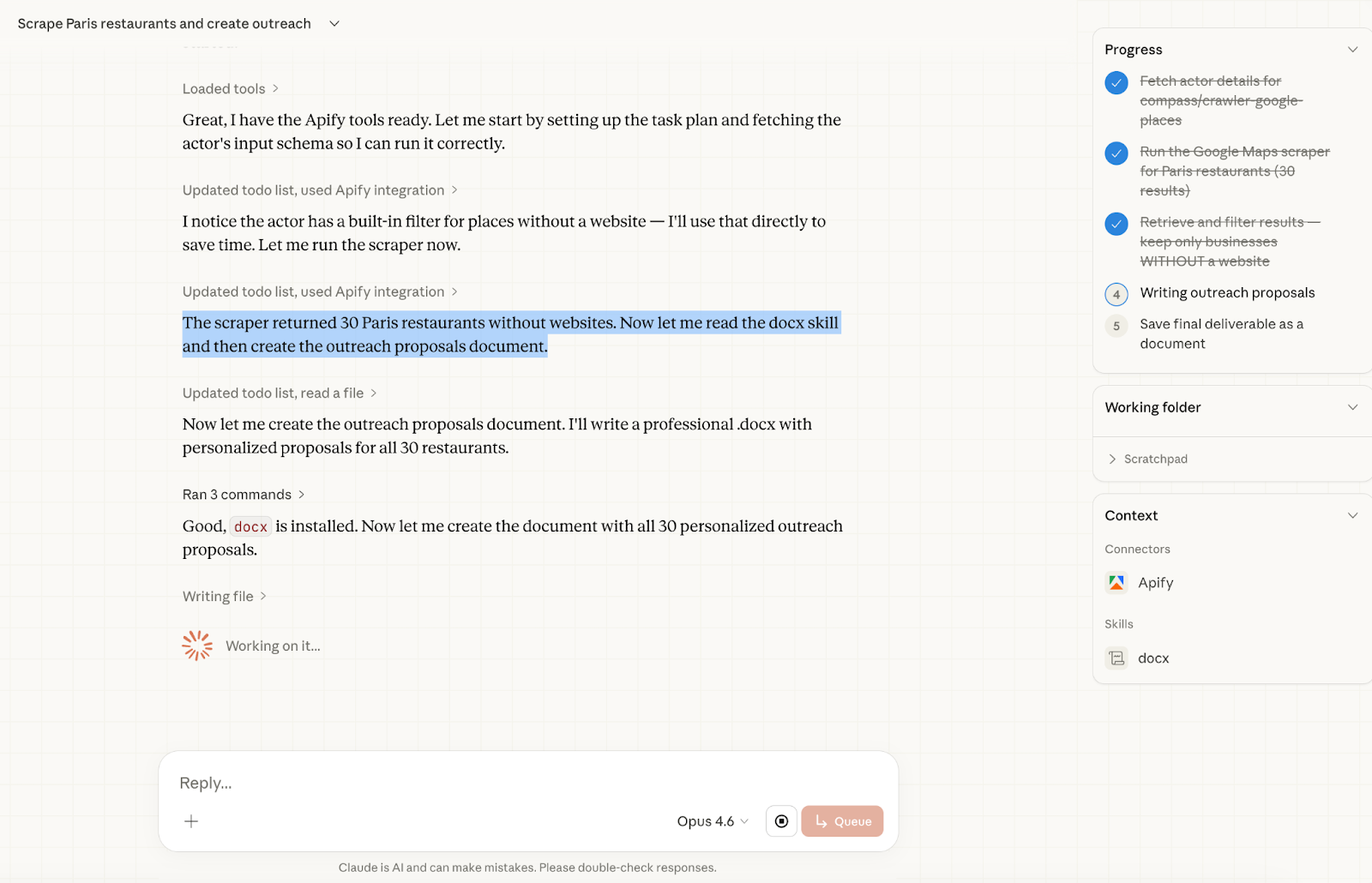
Here’s one idea: pull business data from Google Maps. Point Claude at Google Maps or a directory and have it build you a clean spreadsheet of local businesses, with names and contact info, ready to reach out to.
Lead gen that used to take a full day now takes minutes.
Way two: post content so clients come to you.
This is the long game, and it’s the one I’m most bullish on.
If you can build even a small audience around Claude, it sets you up for the rest of your career, whatever you decide to sell next. You post about what you’re learning, people see you as “the AI person,” and some of them start DMing you to work together.
But here’s an honest take. Getting views on social media is not easy.
If I had to start over, I’d avoid YouTube, LinkedIn, and Instagram. They’re hard (even for me now!). The best platforms for new creators are TikTok and my recent discovery, Threads. Both still give you views regardless of how many followers you have. I started with 0 followers one week ago on Threads, and now I have almost 1k followers (all organic)
Here’s one idea (that works for me): Find content that’s already going viral about Claude/AI and make your own version. Copy the structure, the hook, and then say it in your own words.
Pro tip: Turn one project into income that repeats
Landing a client is great. But one-time projects mean you’re always hunting for the next one. The real goal is income that repeats.
The first move is simple: don’t end the relationship when the project ends.
After you deliver, stay on as their ongoing “AI advisor.”
For an audit client, that might be a few thousand a month to keep their roadmap fresh. For a tool you built, it might be a smaller monthly fee to maintain it and add features.
The second move is the one that quietly changes everything: productize your work.
Every project you finish has reusable parts: the template, the system, the setup. Polish those parts, record a simple walk-through, and sell it as a product. You built it once, for a paying client. Now you sell it again and again to people with the same problem. Of course, you won’t always be able to sell it as is. You might need to adapt it to each business context, but you’re not starting from scratch anymore.
One more thing
Don’t quit on day three. Most people look for clients or post once, hear crickets, and give up. The ones who win just keep showing up. Give it a real shot, say the next 90 days, before you decide it doesn’t work.
Join my newsletter with 60K+ people to master AI in 2026
This is invaluable!
I collected a few good points about concentrating on services rather than building apps.