


Since I moved to Europe, I’ve renewed my love for languages. Over the past months, I’ve been practicing the languages I speak and even started learning a new language just for fun.
I feel that it’s easier to learn a language with ChatGPT, and, in this article, I’ll show you why.
Table of content:

1. Grammar Feedback
2. Chatting Practice
3. Learn Formal and Informal Speech
4. Increase Vocabulary
After reading this, check out my other ChatGPT guides for language learning:
Improve Language Skills with ChatGPT (speaking, listening, writing, reading)
Increase Your Vocabulary with ChatGPT (+how to create your prompt)
1. Grammar Feedback: This prompt makes ChatGPT correct your mistakes and provide an explanation
The most basic, yet useful way to use ChatGPT to learn a language is using it as a language tutor that corrects your mistakes, provides an explanation for the correction provided, and gives examples.
Here’s the prompt I’ve been using for this task.
Act as a language tutor. I’ll provide you sentences in [English] and you’ll correct them so it’s gramatically correct and the formality is neutral. You also need to provide an explanation to the correction provided and give examples.
After running this prompt, just give ChatGPT a sentence to analyze, and it’ll provide feedback.

I can’t tell how many times I made the grammar mistake above. Grammarly helped me correct it, but it didn’t give an explanation or examples, so I ended up forgetting about the correction.
I’ve tried the prompt with different languages I speak, and it’s as helpful as with English.
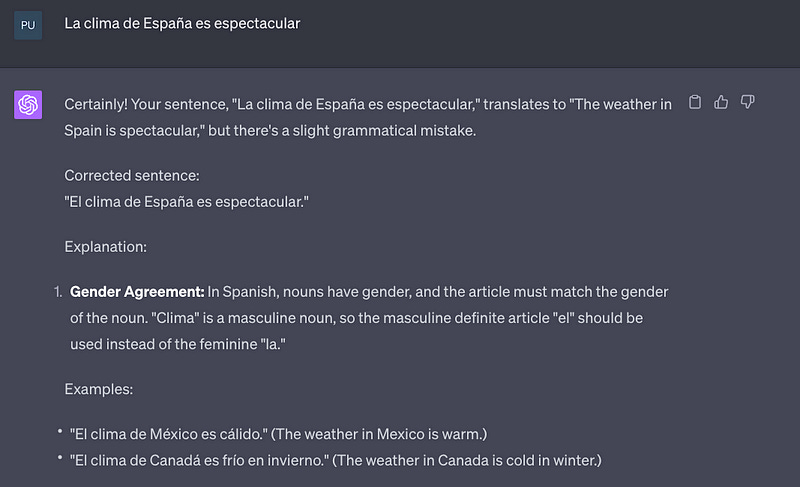
Just note that ChatGPT hasn’t been equally trained with data in different languages, so there might be a decrease in performance for some languages.
2. Chatting Practice: Turn ChatGPT into your language partner
You can tell ChatGPT to behave like a language partner in order to simulate a conversation and practice your language skills.
Act as a language partner. You’ll start a conversation with me about [topic] in [language]. In every response, you should provide your opinion and then ask me a question to keep the conversation going.
Now it’s up to you what topic you want to talk about and in what language you want to practice. I chose Portuguese!
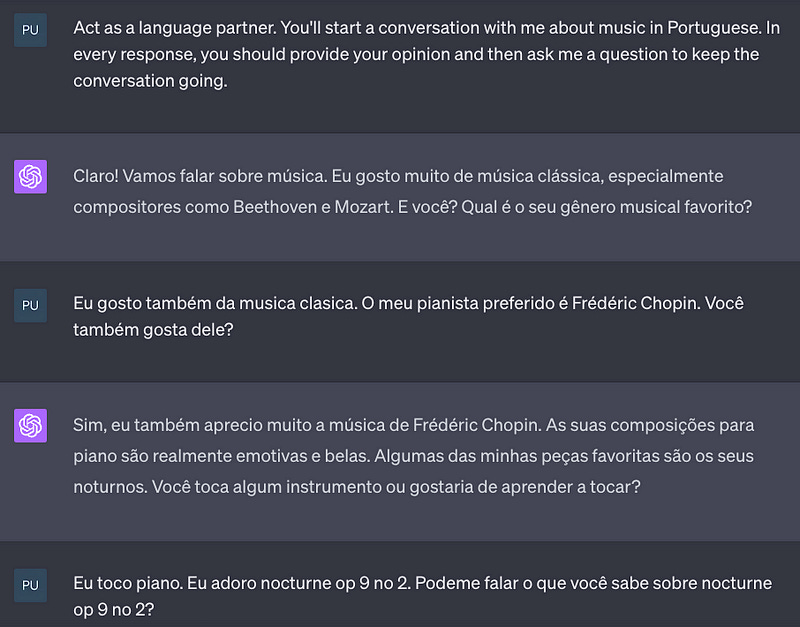
Happy to know that I still remember many words in Portuguese.
3. Learn Formal and Informal Speech
Learning both formal and informal speech helps us use the right formality and tone based on the situation we’re in.
Whenever you read something that is so formal or informal that you can’t understand its meaning, use one of the prompts below.
Here’s the prompt I used to convert informal speech to formal speech.
Act as a language tutor. I’ll provide you expressions that native [English] speakers use in informal [English] and you have to convert the expression into neutral speech and also formal speech.
Here are some examples.
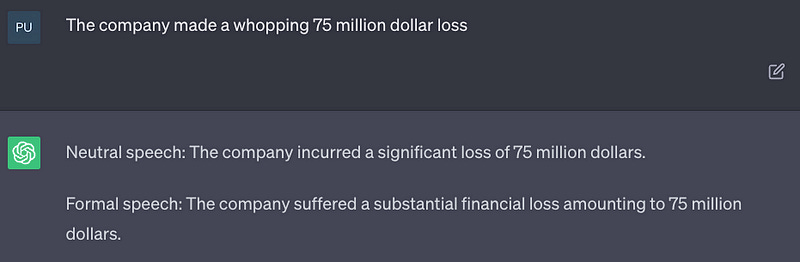

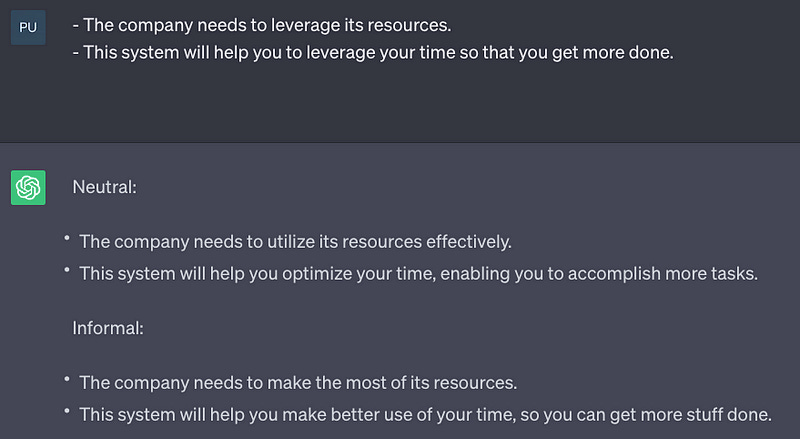
Here’s the prompt used to convert formal speech to informal speech.
Act as a language tutor. I’ll provide you expressions that native [English] speakers use in formal [English] and you have to convert the expression into neutral speech and also informal speech.
Here are some examples.
4. Increase your vocabulary
In a previous article, I talked about a prompt I created to improve my vocabulary. The prompt below does the following:
It provides the definition of the word, examples, and meaning in the given context
It presents word families (to learn multiple words instead of 1)
It automatically builds a database of new words learned
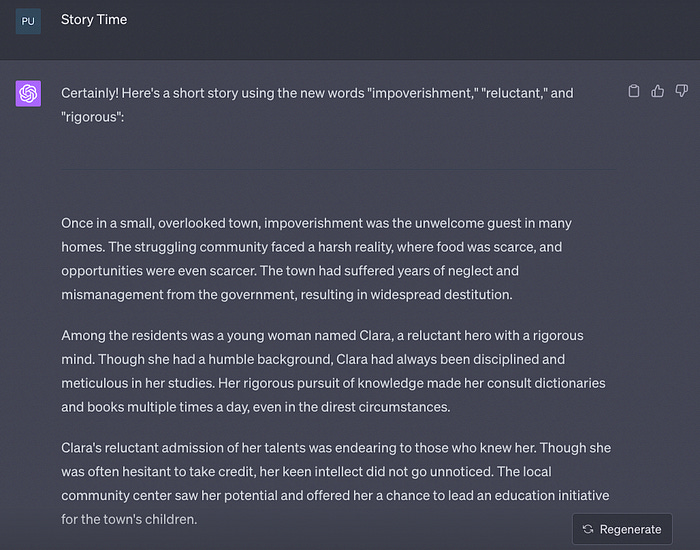
It creates a story using all the new vocabulary
Here’s the prompt I created.
Act as a language tutor. I’m going to give you new words I’m learning to increase my vocabulary. For each new word, I’ll give you context. You have to write the meaning of the word, provide 3 examples of how to use the word and explain the meaning of the word in the given context.
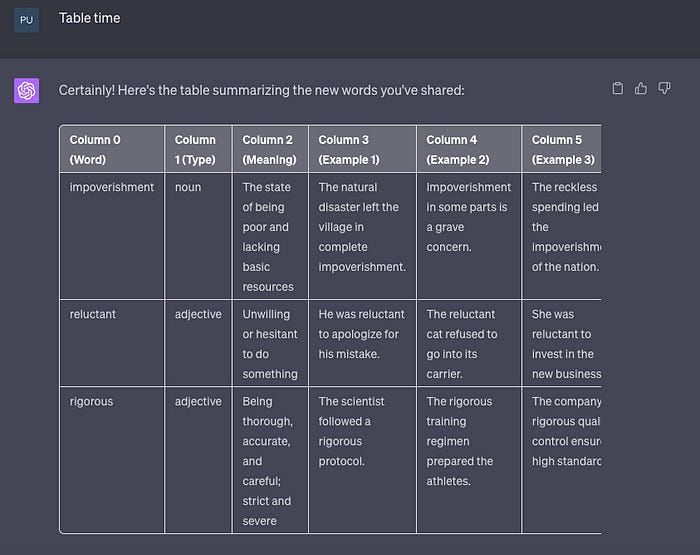
Only when I type the words “Table Time” you have to build the table below.
Column 0 (Word): New word
Column 1 (Type): Classify the word as a verb, noun, idiom, phrasal verb, etc based on the sentence I gave
Column 2 (Meaning): Write the meaning of the word
Column 3, 4, 5 (Example 1, 2 and 3): examples of how to use that new word
Column 6 (Family): Provide the word familyEvery day I’ll give you new words. You have to update the table every time I give you a new word. Finally, when I tell you “Story Time” you have to create a small story using all the new words you added to the table.
Say “yes” if you understood all this
Every time I come across a phrase I don’t quite understand, I’d copy and paste it to ChatGPT and indicate which word I don’t know. By using the prompt above, ChatGPT helps me learn that word.
After weeks, I built a table with all the new words I learned.
A couple of times per week, I sit to read a story ChatGPT creates using my new words from the table.
That’s it! I have a few other prompts I use to learn foreign languages, but they’re more related to the grammar rules of a particular language. Let me know in the comments if you have another prompt that works well for any language!
Check out my Google Docs for more up-to-date ChatGPT for language learning guides